Steve Yegge on Vibe Coding
Steve Yegge talks in the interview about the future of programming and the challenges of vibe coding. The author shares his experiences and sees a upheaval comparable to the introduction of high-level languages.
Steve Yegge talks in the interview about the future of programming and the challenges of vibe coding. The author shares his experiences and sees a upheaval comparable to the introduction of high-level languages.
Now the new software is starting to be fun, everything you need for usage and creation is largely present. It still has a few minor flaws and there are one or two features I want, but I can already do everything I really need as a minimum. Publishing now works easily with a shell script:
#!/bin/sh

cd ~/Blogs/rfc1437.de/html

rsync -rav --delete \
	--exclude='thumbnails/' \
	--exclude='media/' \
	* git.rfc1437.de:git-server/html/

cd ..

rsync -rav --delete thumbnails/ git.rfc1437.de:git-server/html/thumbnails/
rsync -rav --exclude='*.meta' --delete media/ git.rfc1437.de:git-server/html/media/
Yes, that was just to test my source formatting. And?
Schotten Totten 2 is becoming one of our favorite two-player games. A remake of the old Schotten Totten (which unfortunately is no longer available under that name, only as Battle Line, but that only in English). Unlike the first game, now asymmetric with just enough difference in gameplay that the two sides definitely feel different, but still mostly doing the same things. Quick to set up, quick to play, and quick to put away with enough tactics to keep you hooked for a few games. And the graphic style is just nice.
Tak is quite an interesting game: inspired by a fantasy novel by Patrick Rothfuss, brought to life as a fictional "classic" strategy game. The beauty of it: you can easily make it yourself if you want and are skilled. The rules are super simple and easy to learn, but the game is tricky with many opportunities to set traps for the opponent. It will probably be taken for our next vacation because it's practical to play outdoors.
... and of course, the surround sound of my notebook no longer works, for reasons. And fingerprint login makes a lot less sense when you have to enter the password for the keyring after login anyway. If it at least came up for the first time when a password was needed, that would be okay, but it comes up directly after login. Bah.
Otherwise, however, I am pleasantly surprised at how good the Linux support for the Lenovo T480 is. Everything else has been working flawlessly so far.
Prime Time for Prime Slime is the second of my "reinventing the past" deck lists. It is actually my first commander precon deck - Mimeoplasm - just spiced up to 11. It kinda is funny how I stuck with the theme of the deck, transitioning it from the precon to Ooze tribal and later reanimator, then turned it into Muldrotha combo and again turned it back to Mimeoplasm, when the Prime Slime secret lair came out (I love the art style), going full on Necrotic Ooze combo this time. It is a ton of fun to play, which is why some of the old stuff from my collection made it's way into that deck. #EDH #MtG #MagicTheGathering
Well, we found a solution. And it went really well - 6 players were involved, each at home. I had the game and a camera setup to put the image on the internet - and then deliver it to everyone at home with Microsoft Teams. Then headsets and off we went, explaining the game, playing, talking about it together - all of this is also possible during times of social distancing.
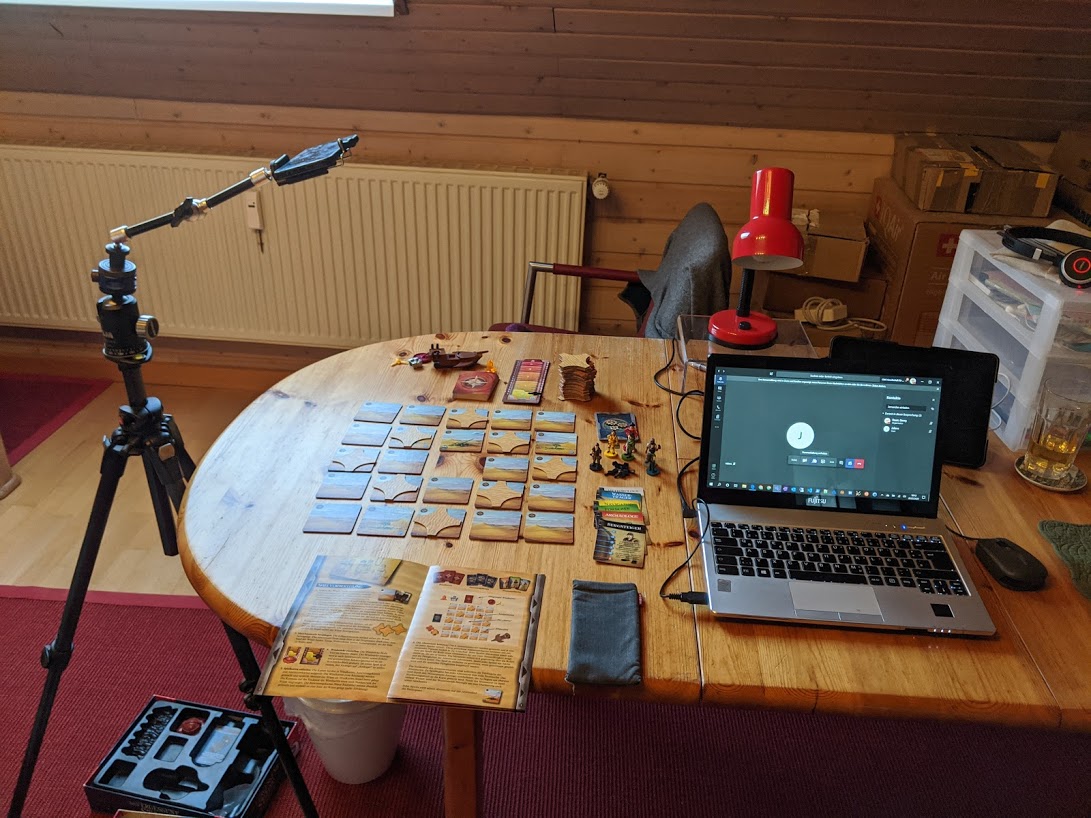
I already had the camera tripod, the small swivel arm with phone holder costs 35€ and the phone - you often already have something like that. Then on the phone a small app - "IP Webcam" - with which the phone's camera is accessible via a website. And on the notebook Teams, with which I shared the browser window with all participants. And off we go!
Bears on a Plane is my attempt to build an effective Prison deck in cEDH. First attempts with the deck were accordingly "disgusting". Can only be tested sporadically due to Anger-Management-Issues of the Playgroup ...
Marvel Champions - Fantasy Flight Games Wow, this is unexpected. It looks very much like another offshoot of the LOTR system, albeit somewhat streamlined at first glance. But if it still achieves the gameplay depth of LOTR, that would be great. I do have a well-running Magic game round now, but for in-between, I always found LOTR quite exciting, as many game decisions (specifically the scenario-specific building of a deck) are very close to Magic.
The London Mulligan will be the official mulligan in Magic starting with Core Set 2020. Great. We tried it in Commander and it was completely fine. And it was also good in Pauper. Of course, there are certainly a few decks that benefit excessively, but that can be regulated otherwise. The new mulligan simply helps to avoid "non-games" due to multiple bad starting hands. There's nothing more annoying than losing a game in the mulligan because every hand was without lands or only lands.
A Force to be Reckoned With - the new card "Force of Vigor" has just hit two of my decks hard. Jhoira as an artifact storm deck and Paradox Arcum as an artifact combo are both quite dependent on their artifacts and enchantments, such a card can just turn them off. Instant speed. For free. Ouch. If other lists go stronger on mana dorks instead of mana rocks, they have enough green cards to get FoV active. And then I'm out. Jhoira might still be able to hold on, but Storm usually has several vectors, but since artifacts only become instant-speed with Shimmer Myr (and it remains vulnerable as an artifact), Arcum is really hard hit.
May 20, 2019 Banned and Restricted Announcement - Wizards of the Coast just neutralized two of my decks for me - Izzet Blitz needs the free spells to pump its creatures or activate direct damage and Skred Delver needed them to fill the hand in the midgame. Ouch. Okay, lately I've mostly played Tron (or GB Tortex if I was in the mood for wild board states), but still, Skred Delver was always my favorite deck because of its explosive comebacks.
Alright folks, Metaowl has gone all digital today: there was this ancient WP installation running in the background, with various customizations. It was simply beyond saving, getting it to fly with newer PHP versions just takes too much time. I also don't think anyone will notice that the owl is no longer there. It was just a piece of internet history.
I like the new MTG Mulligan variant that is to be tested in London. Definitely, it must be seen whether this does not favor combos too much, but the current mana system and the structure of the current Mulligan simply lead to non-games too often, especially in my favorite format EDH. And it just feels stupid when you have to go down to 4 and still have a crappy hand, or then just scoop - and the others can discard their good starting hands because they would otherwise have a game with N-1 players, where one watches. Of course, in multiplayer, you can directly offer the other a further 7-card Mulligan, but the new variant would not make this necessary - I can always choose the best N cards from 7, so a 4-card Mulligan is bearable.
Nemo's War (second edition) I have now played twice, and it is becoming one of my favorite solo games. It captures the atmosphere of Jules Verne's books well into an entertaining game. Even if, of course, the theme is only carried by the cards and the graphics of the game. The game system is based on a lot of chance, which can be surprisingly well managed. The result is quite a bit of strategy in a yet relatively classic roll-for-success system. The playtime, however, prevents me from getting it on the table more often. Nevertheless, it ranks high on my list.
A few days ago, The 7th Continent finally arrived after almost 2 years of waiting. Wow, it was worth the wait! The game has turned out fantastic and has made it into my top list. If the fun continues, it's a clear favorite for the 10th place. The only thing that could have been left out are the fiddly tiny miniatures, I prefer the cardboard standees ten times more. But the game itself - simply grand. Very beautifully drawn cards, clear symbolism and simple game system - all together form a graphical choose-your-own-adventure game. Looks simply great on the table. In addition, a clever save/restore mechanism makes it trivial to pack away to free up the table (you have to eat sometimes). When continuing to play, there is a bit of sorting work, but it is also clear. And the story you experience is really worth the time you invest. In addition, a series of curses that you can expose yourself to and many adventurers that you can send on the journey, that offers a lot of replay value. Even if you naturally get to know the continent over time, it probably won't get boring. This will bring a lot of gaming fun and for the autumn the next Kickstarter with more curses is already announced. I think I'll be there again.
Warhammer Quest: The Adventure Card Game I've had for a while, but only today had the chance to play it. The game is very similar to Space Hulk: Death Angel, but much more expanded. Even in the tutorial, there is much more decision space and you have much more of a feeling of control. It's fun and the different scenarios promise even more of it. Specifically, the upgrading of action cards looks interesting, but unfortunately is not part of the tutorial. But it definitely makes you want more. Setup is much more than in SH:DA. So let's see how often it actually lands on the table, especially since Arkham Horror LCG is also announced, which goes in a similar direction.
51st State: Master Set is one of the newest games from Portal Games and a remake of the old 51st State with all expansions and revised rules. It practically brings Imperial Settlers back to the post-apocalyptic world of 51st State. I really like it. The asymmetry of the factions is not as pronounced as in Imperial Settlers (there by the own card stacks), but the game is much smoother and feels faster and more interactive. And the solo game is easier to play. Overall, I really like it, especially for the solo game even better than Imperial Settlers (although I still have to try the nation-specific AI and the campaign there).
Codenames: Pictures is the sister game of the Game of the Year - only with pictures instead of words. Tried it with Juliana using the two-player rules, and it works surprisingly well. Of course, nothing you would constantly play with two people, but it was just a practice round for the next game night anyway. It will definitely be tried out in the group there.
Red7 is a small and fast game for in between. Ideal for waiting for the food or even on the plane, as it only needs minimal space. And despite simple rules and fast gameplay, it does provide something to think about. Additionally, the game is modular in the rules and can be adjusted in complexity. All in all, a really nice game that will certainly come to our table more often.
Mare Nostrum: Empires finally arrived on Friday after almost a year of extra time. It was one of the more complicated Kickstarters. But the wait was worth it for the game. The components are - as typical for Academy Games - fantastic. The game itself is surprisingly straightforward for a game with this theme (cultures in the Mediterranean region with trade and war) and also plays very quickly. My first solo game (two cultures plus barbarians) had an even for me surprising turn - at the beginning Carthage was ahead, reached 4 wonders (the fifth would have brought victory), but Rome could switch to military to put pressure on trade and secure victory through dominance in the areas of trade, culture and military. Great system and I hope to bring it to the table more often.
7 Wonders Juliana and I usually play in the Duell version. But since our Thursday round is growing, we also got the big game - with the Cities expansion you can play with up to 8 players. Today was the first training session with the 2-player variant included in the box. Definitely more cumbersome than the small duel, but equally definitely noticeable how the game can run with larger rounds - and it's fun for more. Just enough interactivity not to turn into a multiplayer solitaire, but enough strategy not to become a pure random number. I like it very much.
Without Fear and Nobility is practically an oldie, but it was new for Juliana and me. I mainly got it to have something small for larger rounds, as our weekly board game evening is slowly growing. We have only played it in pairs so far, but even then the game is very nice. It reminds a bit of San Juan, with the buildings primarily serving as a source of money (and points), the violet buildings with special functions and the role selection. Very interactive and at least with two players even with strategic elements, which, however, in larger rounds are probably displaced in favor of purely tactical play. But it's definitely fun.
Leaving Earth is a game in which players manage a space agency and must carry out missions. The solo version presents some exciting challenges, as you need to win at least half of the mission points available. This is already quite difficult - in my first game, to even have a chance of winning solo, I first had to examine Venus to find out that you can't land there (which allowed me to discard the Venus missions and thus reduce the point load) and then carry out a manned Mars mission. The latter failed due to lack of time and propulsion equipment. But ideas are already circulating on how to make the whole thing run better next time. And that's a good sign for a hard optimization game - here you don't shoot or send old men with atomic bombs to asteroids, here you plan your budget, your multi-year missions, and the risk you want to take. Cool. For Science!
1775: Rebellion hit the table for the second time today and was another great success: a draw, both sides controlled 5 colonies, and North America became a southern province of French Canada. The best of all possible outcomes when you look at today's presidential candidates. I really like the game - the strategies must really be balanced, if you want to hold the southern colonies, you also have to defend them, at the same time you don't want to lose the northern ones, because there are many colonies there. England is vulnerable because two hard-to-defend colonies lie far in the north, which the Americans can invade. I was two colonies ahead when I started the last round, but then I lost two colonies - and possibly Juliana could have even attacked three. Juliana also likes it, so it will definitely hit the table again.
Night of Man is a tactical combat game, Aliens vs Humans (or other Aliens). So far, my favorite game in the niche has been Hoplomachus, as it captures gladiatorial combat, which is its theme, quite well. And because it has solid solo rules. Night of Man complements my collection with more extended combat, also with solo rules. However, the rules themselves are also the biggest drawback - they are quite well written, but during the game, gaps and weaknesses become apparent, symbols without explanation, or situations that are not clarified. More careful development of the game would certainly have helped here. But if you use common sense, you can solve most things yourself. The game itself is very entertaining. The impulses go quickly, the game does not stall for long, as you usually only activate a few units (often only one). This way, both sides have something to do, and the reaction cards provide even more interaction. Definitely makes you want more, especially with the solo rules (so far it was left hand against right hand). And the components are well made, and especially the counters are very old-man-eye-friendly.
The Gallerist Review – A Masterpiece – Wolf's Gaming Blog is a good review of one of my favorite heavy games. This reminds me that I should definitely take the box out of the closet again.
Dawn of the Zeds (Third edition) is one of the Kickstarter deliveries I've been eagerly anticipating this year, which finally arrived a few days ago. The anticipation came from the fact that it's from one of my favorite publishers - Victory Point Games - who have ventured into mass-market production with this one. No more print-on-demand with laser-cut components, but professional production in high quality was the goal. Add to that the fact that Dawn of the Zeds is the pinnacle of the States of Siege series. Essentially tower defense with control of events and enemy attacks through a configurable deck of cards. The result? Wow. Simply wow. The components are absolutely top-notch, the entire material looks fantastic. The modular game system allows for different difficulty levels, both for cooperative play and for one-against-many. Plus, there's a No-Brains mode, which essentially offers an extremely simplified system for beer-and-chips evenings. The game is most comparable to a zombie movie, the story is built up excitingly and the prepared decks of cards keep the tension high. Absolutely fantastic gaming experience. The setup is a bit cumbersome, as all the elements need to be prepared, but it's within the acceptable range for such a game. This will definitely hit the table more often, as even in solo play, the whole thing is extremely fun.
UBports could potentially breathe new life into my old Nexus 5 when purchasing my next Nexus, which would be more than what was possible with my old Galaxy Nexus.
I am particularly fascinated by games with a scientific background. That's why Greenland was an obvious choice for me. The author Phil Eklund is known for his very intensive study of the themes of his games. This is also the case here - the struggle for survival of the Thule, Tunit and Norwegians in Greenland around the year 1000 is thematically addressed, especially the changes brought about by the Little Ice Age and the resulting changes in life and migrations. The result is a remarkably dense game with a lot of strategy and tactics. The rules are somewhat very compactly structured, but can be mastered with a bit of reading - or simply watch a few of the videos on the game page at BGG. In principle, not really much new in terms of techniques and mechanics - worker placement with dice decisions about success, resource management and an event engine that builds up the necessary pressure. The solo variant is solid and can be well adapted to your own requirements. Multiplayer I unfortunately haven't been able to try out yet, as the game is only available in English. But for solo, a clear recommendation.
1775: Rebellion is a game about the American Revolutionary War. Solidly situated in the War-Euro area with surprisingly compact rules. But not just Risk-with-theme, but quite strategic. I particularly like the very compact game situation with only 12 cards per faction - in the 4-player mode, it's played 2 vs. 2, with two players each playing two factions. Due to the small number of rules and cards, even the first game plays relatively quickly and you quickly recognize the strategic and tactical possibilities. And despite its compactness, the theme comes across well in my opinion. Definitely fun for more!
W1815 really surprised me on the first play: I expected a dice fest with wild randomness and little control in a historical setting. But I found a quite tricky dice puzzle. Of course, everything is left to chance, but the actions of the corps with reactions from opponents (even in chains) make the whole thing interesting - I constantly have to assess which risks and opportunities arise. In addition, the corps change depending on the situation and thus change the planning situation. This quickly brings surprisingly much deliberation and planning. Which is then of course rendered useless by the dice. And the whole thing works surprisingly well solo, simply let the dice tell the story of the battle (or a possible alternative story) and influence it by selecting the corps. Very relaxing and plays in 15-30 minutes.
Analog charm in digital times: With the new M-Series camera, Leica omits the display. Through this reduction, the user of the Leica M-D should only focus on their subject
Source: Ohne Display: Leica M-D ist eine analoge Digitalkamera - Golem.de - the joke is, I would actually like that. I ignore the screen on my M8 anyway and if my camera offers it (like the GH1), then I fold away the display. But for 6000 Euros? Nope.
Got the chance to demo Trickerion: Legends of Illusion and took advantage of it. Nice event, even though we were only there for the first half. I really like the game itself - I've only played the base variant though. But I generally like games with multiple play levels. The game is a very interesting implementation of Worker Placement. With a really well-implemented theme, the actions and components all make thematic sense (ok, the action-promoting crystals only remind me of amphetamines, but the rest was consistent). Many good decision-making situations in the game, very compact gameplay with only 5/7 rounds, but still a lot to do and want to do per round. And you always have to keep an eye on the opponents to benefit from their actions (for example in the theater or with quick orders). It was a lot of fun and I'm already looking forward to October when I get the German version.
Hoplomachus: Origins has had me in its grip with its solo trials for a few days now. These are less of a full solo game and more like small scenarios with the challenge to break them - to find a solution by combining gladiators, tactics, and moves that can reliably defeat the scenario. Very quick to play and the AI for the opponents is surprisingly effective despite its very low complexity. It's quite fun and can be played quickly in between other things.
"We are the people!" came to the table for the first time with Juliana yesterday. As with my first solo round, however, only for the first decade, because that already shows all aspects of the game for the first learning, but does not immediately overwhelm you with the full program. With this game, I hope that Juliana's interest remains, because it is really very well made. It is essentially a mix of resource management with a bit of area control mixed in and - for the East - a good dose of State of Siege. Both sides play very differently, the West plays an economic development game with integrated attacks on the East with ideology and standard of living, the East is constantly fighting for survival and trying to put out all the fires, so in principle classic scarcity management. The West wins through the dissolution of the East, the East only has to survive until the end to win. From these very asymmetrical approaches and goals, a exciting tug-of-war between the two German states then results. The whole thing seasoned with a historical theme. Very cool.
zeromq/netmq: A 100% native C# implementation of ZeroMQ for .NET was completely unknown to me (the C# version, not ZeroMQ), but it is a really exciting project for .NET enthusiasts. Directly in .NET without external libraries or even servers, you can build various 1:1, 1:N, N:1, N:M communication structures with diverse behaviors (Pub/Sub, Broadcast, Req/Resp, Fifo - basically everything that ZeroMQ can do). It makes a very good impression (ok, no surprise, it is after all an implementation of the original ZeroMQ in C#, and ZeroMQ was absolutely brilliant for its purposes). And of course, it is interoperable with the original ZeroMQ.
My first COIN (Counter Insurgency) game is Cuba Libre - and it came to the table for the first time yesterday. What a great system. It is complex with many elements, but the material (board, player aids, sequence of play aid) makes it easy to follow the flow of the game and not forget in the middle whose action it is, who is next and what they are allowed to do. Thematically, the game is also very well connected with the mechanics - the Syndicate builds casinos and grabs money where they can, but are relatively locally active, the Directorio forms many smaller cells across the island and tries to disrupt both sides and position itself in many parts of the country, Batista squanders his money (which he gets from the USA and the Syndicate) on massive police and military actions against the rebels and Castro's side tries to convince the regions of the revolution and to motivate as many regions and cities to oppose. My game was Castro against the rest (controlled by bots) and unfortunately was not successful - the Syndicate had corrupted the country too much. The bots showed quite well the character of the other factions. Ok, the whole thing took 5 hours, but it was also the first game. Next time it will run more smoothly. And there will definitely be a next time, the game is simply fantastic. And I am already looking forward to the upcoming expansion and the two upcoming COIN games about the Gallic Wars and the American Revolution. Cuba Libre only has about 56 cards, so I am already thinking about translating them - then I would also have a chance to play it with Juliana. More complex than our usual gaming fare, but worth it.
After a long break, I played Sentinels of the Multiverse again. It's still a really entertaining game. But I'm increasingly noticing that while it's a lot of fun, keeping track of various effects in the paper version really takes away my desire to pull out the cards, so I prefer to play it on the PC or tablet instead. Which is a shame, but I notice even in the digital version that there are moments of "oh, I didn't think about that modifier anymore," and in the paper version, it becomes really annoying. Even the many markers don't really help. On the other hand, it's a purely cooperative game without decisions for the opponent, so it can also be well implemented on a computer. For a solo game, this is perfectly fine and much more convenient.
I received Hostage Negotiator a few days ago and tried it out. A very interesting implementation of an exciting topic. It has the classic wargame structure: decide on a plan and the dice tell you whether the plan succeeds. The chances for this are not particularly good. Therefore, it reminds me of the State of Siege games like Soviet Dawn or Cruel Necessity, where it is the same. Here, too, you always have to keep an eye on the risk, but luck plays an even greater role than in the SoS games. Therefore, I don't know if it will stand the test of time alongside Soviet Dawn (which is even faster to set up) - but it has the advantage of higher variability. Compared to Space Hulk: Deathwing, it stands up well in my opinion, the box is also small, a series of expansions bring variety, so it will at least have a place as a travel pack. And it will certainly spend some rounds on the table.
Soviet Dawn is another State of Siege game. This one was included in C3i 27, a real bargain. Thematically very dense, as with all State of Siege games so far, the playtime is much shorter than in Cruel Necessity. I like it very much, despite the dice fest it is already noticeable that you have a chance, but only very narrow. Thanks to the short playtime, good chances to hit the table more often, just because I find the theme (early Soviet Union after the revolution) exciting. Nice solo game for in between.
Junior General is a very interesting website with many (free!) paper "miniatures" for classic miniature-based wargames such as Professor Sabin's Lost Battles: Reconstructing the Great Clashes of the Ancient World. Easy to produce (print, fold, glue, done) and give the battlefield a 3D feel with minimal time and money investment.
I finally managed to bring Mage Knight Board Game to the table for a solo learning game. Still with reduced walkthrough rules to get a feel for the ruleset first, then next time I'll dive into the full walkthrough rules. There are quite a few corners to consider, and unfortunately, the setup is a bit more involved (though not much worse than, for example, The Gallerist). I still need to come up with something for organization. But overall, it's already an impressive game. I like these more puzzle-oriented cooperative or solo games, and the theme definitely appeals to me. This will definitely be repeated. And I'm also looking forward to the re-releases of the expansions, especially the Lost Legion and the brand new expansion, which offer a lot for solo play.
The Lord of the Rings: The Card Game is a regular guest on the table, at least when I play solo. Not every round is remarkable, even though the games are usually fun. But yesterday, I sent my renovated Ent deck into the race for the first time, this time against the first scenario of the Black Rider. And the result was impressive. The deck didn't run smoothly at all - only a few Ents, only one of the Ent Grave events (where you can take all Ent cards from the top 5). No Shadowmane for Gandalf. So not really optimal - and yet the deck held up extremely well. The situation never really became dangerous, the black riders (though also with a lot of luck, none of them got their mount) were not a real threat, as I could almost always pull them out of staging to block them cleanly and then shred them with a few Ents. Thanks to some Quick Knots, the Hobbits were always available to send them to hiding tests and in case of emergency they could be improved with Ents. And Treebeard was soon there as a solid defender and quester and additional resource source. The switch away from Treebeard as a hero to Gandalf definitely gives me a good piece of control over the player deck, which helps a lot with a sluggish start of the deck - especially with poorer development in the first rounds, the old version was quickly overwhelmed and here I had to face 9-11 threat in the lineup very quickly. A really nice deck and I think I can let it run against the whole campaign.
The Gallerist hit the table for the first solo game today. Wow. It's almost like work. But it's a lot of fun, even though I made way too many mistakes in the first solo game - the game system was already quite recognizable. The actions make sense and are thematically very well founded, which makes learning much easier. And the best part: it's really fun. The two hours flew by. This will definitely be repeated.
Selection for the next big game that Juliana and I learned together was over the weekend The Golden Ages and we have the first learning game behind us. It was still a bit bumpy, the game has significantly more moving parts than anything we have played so far. But it was fun and the structure is quite logical. You just have to think about a few things during the change of epochs. All in all, however, a really beautiful game with a lot of possibilities and variable setup, that should keep us busy for a good while. But I don't think Progress will be dethroned so quickly.
Progress: Evolution of Technology has become a total hit with Juliana in recent times. We've practically played it every day, even 2-3 times a day during the time I was sick. And we're both still having a great time with it. The advantages of the game are manifold, but apart from the interesting theme, the highlights for us are that all actions make sense in the context of the game theme. Cards that build on each other are logically connected (in most cases, at least), and the improvements that come along are indeed connected to the card. Additionally, the cards themselves have no text except for the name - you don't have to read long to understand what's happening, everything is marked with clear symbols. On top of that, all the cultural improvements you earn are clearly visible on the player board. The same goes for the position in the cultural areas (prestige, population development, and military) on the additional board. The available aids are easy to use and understand. All of this helps to ensure that you can really just play casually without being held back by questions of understanding (especially for Juliana, the language difference is crucial). On top of that, a really exciting game theme for us, and our evening entertainment is secured. We've now reached 1-1.5 hours, although we always play with the fourth age. Milestones and philosophers are not yet included in the program, but it might become interesting soon, but with 20 games together, we haven't yet felt that we've exhausted the base game.
Why Twitter’s Dying (And What You Can Learn From It) — Bad Words — Medium is an interesting article about what the author sees as the core problem of social media, which is ignored by the operators: abuse, or (since "abuse" doesn't translate trivially) the antisocial behavior of many in these media, which drives away normal users and turns some networks into pure self-promotion machines for press organs. The latter part of the article, about the digital revolution, is then somewhat too dreamy.
The Lord of the Ice Garden I backed and received through Spieleschmiede. And the game is a visual masterpiece - great graphic design and excellent miniatures. Plus, it's a very interesting game with a truly non-trivial solo variant that actually retains a lot from the original game. However, it's very high in complexity, it will take a few more rounds until I really understand it to explain it to someone. But it offers a combination of worker placement and area domination together with variable player abilities and upgrade options like I've never seen before. Absolutely wow.
Holy Smokes, Per6 is officially out!
Quelle: The Night Larry Wall Unveiled Perl 6 | 10 Zen Monkeys