Archive 20.2.2005 - 24.2.2005

The Mouse's Elephant Turns 30

The little blue elephant from the show with the mouse is turning 30. Let's all congratulate him very warmly: Trööööööööt

Funny. No matter how old I get, I still love the mouse and the elephant. I even have a picture of the two on the wall. Just no plush elephant. And no plush mouse.

Energy drink for RWE - at our expense

Energy drink for RWE. Great, RWE makes profits despite shoddy management, and we finance their antics with higher energy prices. Fantastic. Let's all cheer for RWE.

Stock market news sometimes can't be beaten for stupidity - the fact that RWE simply exploits a monopoly and squeezes the market without creating real added value is all the same to them. As long as the stock price is right.

And the consumers? Their electricity bill has risen significantly more than the dividend they receive for their three shares, but we all dream of being the great stock market crooks ...

Artists of the Brücke in Essen and Münster. In Münster I will definitely go, but Essen is only a regional train ride away and I probably won't miss that either.

US-Ministerium hires adware manufacturer as privacy advisor - gives the saying of the goat made gardener a whole new dimension. Maybe they should also make the KKK chief an advisor for multicultural affairs? The Unabomber a security advisor? Bush president? Oh well, they've already done that ...

Virtualized Servers under Linux

rHype is an IBM project that was recently published under an Open Source license (GPL). This project is essentially a virtualization machine for Linux. Comparable to IBM's LPARs for mainframes, but naturally designed for much smaller machines.

It could be the ideal complement to Xen - another GPL project for virtualization based on Linux. Taken together, both could become an interesting open source alternative to VMWare.

Virtualized servers are very interesting for many purposes, as usually only a virtual machine is lost in case of problems and the migration of services on virtual machines is easier than moving around real hardware. Better to have a few large boxes with virtualized servers on them than many smaller boxes with dedicated systems.

Virtualized servers in real use can be done with User Mode Linux today. In this case, a Linux kernel is operated as its own process under the actual hardware kernel via special APIs in user mode instead of directly on the hardware. Each virtualized machine has its own user mode kernel, its own memory, and its own virtual disk areas.

Caution with free SSL certificates

Beware of free SSL certificates - the criticism of the unchecked certificates is indeed correct. But the experts are sitting on a misconception here: why should I trust the CAs randomly delivered with my browser more than any other CA?

Of course, if I try to get a certificate from them (e.g., at the Trustcenter), I have to jump through all sorts of hoops to get the certificate. That seems very secure. But who guarantees that all certificates from this CA were issued according to the same pattern? That someone didn't feel like checking and simply confirmed a certificate without verification? Or that something was rigged?

Exactly. There is only the guarantee of the issuer. The company that issues me the certificate essentially checks itself. Of course, in Germany there are regulations for certificate authorities and, as far as I know, these include audits - but who guarantees that everything runs smoothly there? Given the level of corruption going on ...

I don't want to accuse the Trustcenter of anything here - on the contrary, we use their services in the company. But central certification authorities have a serious problem: the security and trustworthiness depend solely on the trustworthiness of the central authority. And browsers come with various certification authorities deemed trustworthy by the browser manufacturer - I don't decide that, someone else does.

This is the classic conflict between centralized certification and decentralized certification via a Web of Trust as it exists with OpenPGP or GPG. Of course, I can't trust everyone there either - but if I trust someone, I set that locally for myself. And this trust is not dependent on whether it is a large company with great boilerplate documents.

Without a Web of Trust structure, certification is still more of a facade than substance. Alongside the pearls, there are also pigs - and that's exactly what ct has found out. Great insight - we've been saying this from the PGP camp for years.

A Call to Action in OASIS

A Call to Action in OASIS is an open letter from a whole range of Open Source big names against the latest OASIS framework conditions. OASIS deals with the standardization of data formats and web services, and in the latest framework conditions, standards should also allow those based on patented techniques - and thus ultimately give companies the means to exclude Open Source programs with these standards. In principle, a rehash of the same stupid idea from the W3C - which then withdrew this idea in response to the protests.

Cease and desist letters for Gmail invitations

Abmahnungen für Gmail-Einladungen - great. The madness continues. Now people are being warned who want to sell Gmail invitations on eBay or give them away in blogs. And of course, the brand owner does not go to Google - who operate the Gmail service - but to the end users who only use a name established on the net to describe what they are giving away.

What's particularly silly about the whole thing: the brand owner is based in the same city as Google Germany - if the brand (which is of course professionally operated by Schlund + Partner, like every big and important portal) is really so threatened, why hasn't he even made a local call to Google about it? And the fact that the domain has a Created entry from August 2004 is surely purely coincidental - of course, anyone who thinks of freeloading is a scoundrel ...

For those who are not quite clear that this is not about the brand at all. Someone is sniffing fresh air here and wants to make quick money. Because greed is cool.

Google's legal counsel Lena Tangermann recommends contacting Google Germany by phone (040/808179-0) in case of a warning on this topic.

BA will Betreuung älterer ostdeutscher Arbeitsloser abgeben - how to create new serfs and at the same time beautify the unemployment statistics ...

Bush in Mainz reports on the restrictions residents in Mainz received during the Bush visit. Welcome to the police state Germany - where even peace symbols in the window are not allowed for flimsy security reasons ...

Dialer Madness - the next phase

In Dialerwahn - the next phase Isotopp reports on an IP payment system that generates paid page requests based on logged IPs and the association of these IPs with a user. So far only in use in Austria - but highly stupid. They probably have never heard of IP spoofing, but also not of anonymous proxies and tor ...

IP-based paid services must be based on some form of authorization. Either the classic password technique or better on client certificates. Anything else is highly nonsense and doomed to fail. Anyone who bases billing to end customers on the basis of the logged IP address simply does not understand TCP/IP and the Internet.

EU-Parliament decides to end paper driver's licenses - Scoundrels!

Free multidimensional OLAP server for Linux announced - could be interesting if it changes from the status announced to the status implemented.

New iPod models at lower prices - well, I should probably plan a new purchase for March. A small iPod Photo with a camera adapter could be quite nice for on the go ...

Ole von Beust for a Northern State

Ole von Beust apparently wants to create a Northern state from S.-H., HH and McPomm - I doubt that's a good idea.

However, the three federal states together would have an even greater overrepresentation of rural regions compared to urban regions in terms of population numbers. And thus, the prospect that this Northern state would firmly be in the hands of the Union - despite a few larger red cities and despite Hamburg. Presumably, that's the simple main motivation for them to calculate something.

However, whether the people of Hamburg would give up their independence and not simply vote out this eccentric at the next election is another matter.

Optic Nerve Cameras for the Blind - it does have a bit of CyberPunk, but for the blind, it is of course a real glimmer of hope. Even if certainly not everyone will be enthusiastic about the idea of a plugin interface to their optic nerve, or about having something tinkered with in their head and brain.

The Plugin API for WordPress lists actions and filters defined by WordPress. Currently being filled with content.

Banner for February 23, 2005

Since I am suspected of salon anti-Americanism, I am of course participating and throwing a heartfelt: You're Not Welcome, Mr. Bush!

at the president. And yes, this refers to Bush and his administration - not to Americans in general. So please put me in the drawer of anti-religion fanatics and anti-war agitators and anti-world policemen when you quote me next (and then you can also leave out the salon before that) ...

I've never understood how T-Online derives the alleged market leadership of Musicload. Probably just a blunt marketing lie with absurdly beautiful calculations like "all T-Online users are Musicload customers by definition, even if they never bought anything or will buy anything..."

Apache2, php5-fcgi, php4-fcgi, mod_fastcgi HowTo

Apache2, php5-fcgi, php4-fcgi, mod_fastcgi HowTo provides everything you need to know to run PHP as an FCGI process. And even in German. The little bit of Apache2 in there can be mentally converted to Apache 1.3, the Apache is actually hardly affected.

FCGI offers, in combination with suexec, the possibility to run PHP per virtual host under a dedicated user and thus the possibility in shared hosting environments to set up files in a virtual host so that another user with his PHP cannot read them. You could even run the FCGI-PHPs in a chroot jail to isolate them even more.

In addition, FCGI is often significantly more resource-efficient for PHP, as fewer PHP processes can run than Apache processes and the Apache processes do not become so bloated. If you have many virtual hosts, this can lead to the FCGI processes catching up in number - but then you should consider whether the FCGI processes should not run better on a dedicated machine.

This would be exactly the right thing for simon, especially since I could then also allow PHP for the other users.

Ape can transparently map Python objects in Zope to filesystem objects or PostgreSQL databases. Could be very interesting for work. Can also be used standalone (without Zope).

The Schill Party in Hamburg dissolves - and goodbye. Make sure the door doesn't hit you in the ass on the way out. No need to come back.

Fairsharing Petition

fair_banner_l_blue_v.gif

Go there, sign. Anyway, anyone interested in there being a private copy. By the way, the action also has a Weblog.

Ian Bicking compares FileSystemView vs. LocalFS as alternatives to store Zope objects in the file system.

Leica in financial crisis - oh Shit. Hopefully it works out anyway, or Hermes will shoot after. It would be a shame about Leica.

Microsoft will have invented the inequality command for Basic - and that over a month before April 1st ...

mod_fastcgi and mod_rewrite

Well, I actually tried using PHP as FastCGI - among other things because I could also use a newer PHP version. And what happened? Nothing. And there was a massive problem with mod rewrite rules. In the WordPress .htaccess, everything is rewritten to the index.php. The actual path that was accessed is appended to the index.php as PATH INFO. Well, and the PHP then spits out this information again and does the right thing.

But when I had activated FastCGI, that didn't work - the PHP always claimed that no input file was passed. So as if I had called the PHP without parameters. The WordPress administration - which works with normal PHP files - worked wonderfully. And the permission stuff also worked well, everything ran under my own user.

Only the Rewrite-Rules didn't work - and thus the whole site didn't. Pretty annoying. Especially since I can't properly test it without taking down my main site. It's also annoying that suexec apparently looks for the actual FCGI starters in the document root of the primary virtual server - not in those of the actual virtual servers. This makes the whole situation a bit unclear, as the programs (the starters are small shell scripts) are not where the files are. Unless you have created your virtual servers below the primary virtual server - but I personally consider that highly nonsensical, as you can then bypass Perl modules loaded in the virtual server by direct path specifications via the default server.

Ergo: a failure. Unfortunately. Annoying. Now I have to somehow put together a test box with which I can analyze this problem ...

Update: a bit of searching and digging on the net and a short test and I'm wiser: PATH_INFO with PHP as FCGI version under Apache is broken. Apparently, PHP gets the wrong PATH_INFO entry and the wrong SCRIPT NAME. As a result, the interpreter simply does not find its script when PATH INFO is set and nothing works anymore. Now I have to search further to see if there is a solution. cgi.fix_pathinfo = 1 (which is generally offered as a help for this) does not work anyway. But if I see it correctly, there is no usable solution for this - at least none that is obvious to me. Damn.

Update 2: I found a solution. This is based on simply not using Apache, but lighttpd - and putting Apache in front as a transparent proxy. This works quite well, especially if I strongly de-core the Apache and throw the PHP out of it, it also becomes much slimmer. And lighttpd can run under different user accounts, so I also save myself the wild hacking with suexec. However, a lighttpd process then runs per user (lighttpd only needs one process per server, as it works with asynchronous communication) and the PHPs run wild as FastCGI processes, not as Apache-integrated modules. Apache itself is then only responsible for purely static presences or sites with Perl modules - I still have quite a few of those. At the moment I only have a game site running there, but maybe it will be switched in the next few days. The method by which cruft-free URIs are produced is quite funny: in WordPress you can simply enter the index.php as an Error-Document: ErrorDocument 404 /index.php?error=404 would be the entry in the .htaccess, in lighttpd there is an equivalent entry. This automatically redirects non-existent files (and the cruft-free URIs do not exist as physical files) to WordPress. There it is then checked whether there really is no data for the URI and if there is something there (because it is a WordPress URI), the status is simply reset. For the latter, I had to install a small patch in WordPress. This saves you all the RewriteRules and works with almost any server. And because it's now 1:41, I'm going to bed now ...

Put Your Money Where Your Mouth Is ...

As you can see in the 3M Security Glass Ad (real money in a real installation), 3M seems to take the security of its security glass very seriously. Nice advertising idea - I wonder how many people have already tried to break the glass.

Sony exits the PDA business completely - and that despite having the Clie PEG TH-55, which is pretty much the ultimate Palm OS device ...

Back to Camino from Firefox ...

... and back. Odyssey of the web browsers.

After working with Firefox for a few days, I switched back to Camino. Why? Well, under OS X, Firefox is suboptimal. For one, I have the impression that fonts are generally displayed smaller than in Camino or other real Mac programs. It might be an illusion. However, it is not an illusion that Firefox under OS X does not support Services. And that is annoying - what's the point if a bunch of programs hook into the Services menu and provide useful services that build on highlighted text in other programs, if the main application in which I spend my time on the computer does not support it at all?

Just as annoying was the fact that Tab-X is not supported under OS X. This extension attaches a close icon to every tab. I don't know what the UI designer of Firefox was thinking, but I consider neither the mandatory activation of a tab and then clicking on a tiny X at the right edge of the toolbar to be ergonomic, nor closing a tab via the context menu. Okay, you can get used to that if necessary.

Furthermore, I was constantly bothered by the fact that Firefox has its own password manager and does not use the KeyChain. I find it simply practical that all kinds of programs can register at a central location and that I can delete my passwords there if I need to. In addition, this helps to avoid constantly having to re-enter passwords just because you visit a page with a different browser.

Unfortunately, I lose all the nice things that are available via Firefox extensions - for example, the Web Developer Toolbar. Only that it doesn't work on my Mac anyway, who knows why - so I've only ever had it under Linux, and there I continue to use Firefox. I will miss the plugin for the Google PageRank status and the plugin for mozcc, however - both were quite practical. It's somehow stupid that I can't have both - a Firefox with proper integration into OS X, that would be it ...

Due to the pretty broken 0.8.2 of Camino, I downloaded and installed the 0.8.1 again. At least it has functioning tabs and doesn't crash all the time. I have no idea what they did with the 0.8.2, but it was definitely not to the benefit of Camino.

And of course, right after I wrote this, Camino started acting up. I can't believe it. The 0.8.1 had worked flawlessly before. Nevertheless, there were the same problems as with the 0.8.2 - probably triggered by some sites with which I work more frequently now than before? I have no idea - I haven't installed any special tools under OS X, on the contrary, I have uninstalled one.

So, trying other browsers again. Safari 1.0 under OS X 10.2.8 is clearly behind in features - but it would still remain as an alternative, but it crashes on some pages. OmniWeb is basically a souped-up Safari, but it crashes even more frequently. And Opera doesn't get along with the CSS of the WordPress admin at all - it's wildly mixed up. In addition, it always asks multiple times for passwords and Keychain access when I access some protected pages. And it has had this quirk for months - not very confidence-inspiring.

The IE for Mac is not even a desperation option. Netscape? No, sorry, but that's not necessary. Mozilla also not - then rather Firefox, because Mozilla not only does not integrate well into the system, it also looks completely different from OS X applications ...

The only really usable alternative browser under OS X 10.2 is - despite its problems - OmniWeb. As a last resort, Safari, but OmniWeb is more advanced in rendering on some pages. However, it still does not support things like clicking on the label of a checkbox to toggle it - it is used in the WordPress admin and avoids silly target practice. Except in OmniWeb or Safari. Okay, the fact that the QuickTag bar is missing in OmniWeb and Safari is intentional in WordPress - the JavaScript is not quite compatible.

So, back to the whole thing and use Firefox again and complain about the missing services (which, by the way, can also work in Carbon applications - if the programmer has considered this in his program)? Or just play with OmniWeb and see if you can get around the problems?

And what do we learn from this? All browsers suck. Even the good ones.

Future Bathing Paradise Mars?

Giant ice lake discovered on Mars - wow. So far there have only been traces, but no one has found solid-state water just lying around on Mars before. And then right away a pond the size of the North Sea ...
750 votes ...

... about whether Red/Green with the cooperation of the SSW can govern S.-H. for another 4 years. Ouch. You can't really call that a comfortable majority. And somehow, this doesn't make politics in S.-H. any easier to manage ...

Batch Categories 0.9 can batch-process posts into new categories. It's more of a hack than a plugin, but still quite practical under certain circumstances.

Brüderle threatens with anti-Danish resentments

Brüderle criticizes the SSW and demands that they handle their special status responsibly to avoid anti-Danish resentments - hello, still all your cups in the cupboard? What Brüderle is doing here almost borders on blackmail. Do what we want, or we'll bully you could be read into it. Quite stupid. But that's how they are, our Prolethikers ...

All Clear: Mozilla is not disabling Umlaut Domains - although the solution is equivalent to disabling them: the browser simply displays the Punycode notation. So you can enter a Umlaut domain and land on the correct server, but that's it.

Hack a Bike - keep on hacking in a free world! - no idea how old it is, but the text was new to me. How the Berlin rental bikes were hacked. Even Bruce Schneier commented on it.

Image Headlines Plugin for WordPress 1.5 automatically creates image replacements for headers. However, it probably only handles simple images, so you would still need to place invisible text under the H-tag to ensure that search engines don't just take the ALT attribute of the image for the header. And of course, image replacements have a significant drawback: they do not grow when the user changes the base font size.

Get a Spanner in the Works

Now I'm being pelted with wood here. Well, I'm a good-natured person and it does promote the PageRank. How many gigantic bytes of music are stored on your computer?

7GB of music alone and I don't know how many more GB of audio plays. All completely legally ripped or downloaded. Actually, not much... The last CD you bought...

Haindling, "Achtung, Achtung". Which song were you listening to when the call came?

Kraftwerk, "The Model" (yes, unfortunately the English version - last.fm doesn't have the German one). And yes, I'm an old fart. Five songs that mean a lot to me or that I listen to often:

  • Grummel. That's by far not enough to even begin to ... Give me 50 ...

  • Kate Bush, "Babooshka" (my song, and I won't tell you why)

  • Emerson, Lake & Palmer, "Black Moon" (or anything where they rock - piano not needed, but rock must)

  • Pink Floyd, "Money" (because that's all it's about)

  • Steve Miller, "The Joker" (yeah. simple and plain.)

  • Madness, "One Step Beyond" (because I always feel young then)

Who do you throw this stick to (3 people) and why?

  • [Jutta][2], because she writes so little
  • [Christian][3], for the same reason and because he needs links for his blog
  • [ToJe][4], because he is probably the freshest new addition to the Münster blogosphere

OpenPGPComment for WordPress

OpenPGPComment is a WordPress plugin that allows you to display signed comments properly. Users can sign their comments with gpg, and the server then displays these comments without the signature in the post comments, but offers a popup window with the gpg output as a link. Nice idea.

Digitally signed comments are not only useful for associating comments with users - they also offer advantages for the user themselves. Specifically, it is ensured that signed comments have not been subsequently altered by the server operator. A not insignificant advantage, especially in weblogs, where the server owner usually has significantly more options available.

I would have liked to try it out myself, but it requires proc open - and proc open is only available from PHP 4.3 onwards. And in Debian Woody, there is still a PHP 4.1.2 ...

Paranoia, advanced - so I'm not the only one wondering about these slightly crazy measures. The crazy part: the Americans expect such a show from us. At this point, you almost wish the guy would stay away ...

rdiff-backup and duplicity

rdiff-backup and duplicity are very practical backup tools that use the rsync algorithm to efficiently copy over the network and, unlike normal rsync, also store historical versions. rdiff-backup uses a mirror+reverse-delta format and duplicity uses a base-version+forward-delta format. The latest version of librsync, on which both projects are based, should also transport Mac OS X metadata, so it could also be useful for OS X. I have already successfully used rdiff-backup for Linux backups.

Spammers are really quite stupid ...

... someone is struggling with my trackbacks right now. Every hour. Almost exactly at 25 minutes past the hour. With strongly varying IP addresses. The texts are also very different - and non-spammy. But what is the idiot doing? Trackbacking the same link every time. A link that I already put on the bad link list two weeks ago. Somehow not particularly smart, because everything ends up in the trash directly. Ok, otherwise everything would end up in the moderation queue, which wouldn't help him either.

Rabies (Rabies, Lyssa)

Medicine-Worldwide: Rabies (Rabies, Lyssa) describes rabies and its course in humans. And of course, there is a rabies page on Wikipedia.

Apache Rivet - Integrate TCL as an alternative to PHP into Apache and design dynamic pages with it. Fighting fire with fire?

The Elections in S.-H.

I can't claim that I'm bursting with joy. So far, Hesse has been the epitome of stupid election results for me. But as usual, reality has outdone itself. I can't claim that this causes me any kind of anticipation for the elections in May here ... What is really disgusting about elections: the blabbering of all the social failure politicians afterwards. So much nonsense in one place should be banned. If a Stoiber blathers on that show politics cannot replace real politics - the man who consists only of show and hollow phrases - then the whole thing takes on quite bizarre traits. One could feel like being in a staging of a play of the Theater of the Absurd:

In it, our everyday world is present in terrifyingly distorted forms. The uncanny, as Sigmund Freud, often arises from the overemphasis of psychological reality in relation to material reality. In the theater of the absurd, the characters only perceive the outside world through the prism of their fears, obsessions, and delusions.

Yep, fits. Can I get my ticket refunded and get my money back?

Google-Whack: melted möllemann

Ha, my very personal Googlewhack: gemölter möllemann. I just need to find a dictionary that includes "Gemölter" now.

And of course, all of this is just to solidify my number 1 ranking for "gemölter" ...

mod_dosevasive is an Apache module that attempts to detect DOS attacks and then can hand them off to other mechanisms to block the attacker. It can, for example, generate firewalling rules that block this attacker. However, you should not run it on an SVN host, as an SVN update may under certain circumstances look like a scripted attack ...

Red Alt - Kubrickr

Red Alt - Kubrickr generates a header image for the Kubrick layout from a selection of images on flickr that are licensed under CC. Should be usable for all Kubrick designs where the images have the same dimensions.

I've already toyed with the idea of building something like this myself - we'll see, maybe I'll integrate something like this into my photo plugin. Because I already had changing header graphics before, which I actually quite liked.

Terragen - Landscape Generator

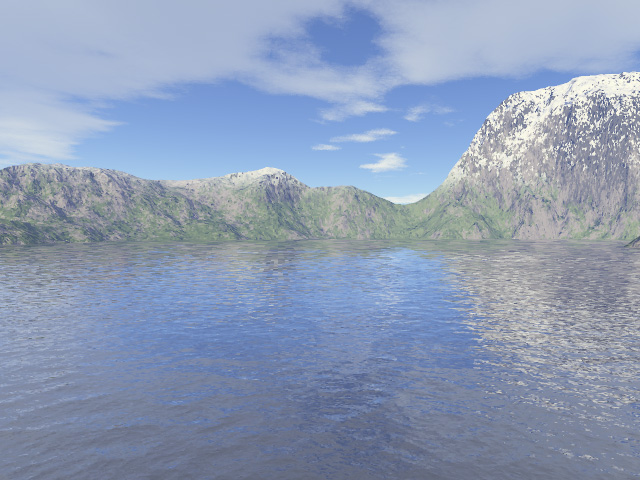
Terragen is a landscape generator for Windows and Mac (Classic and OS X). Very interesting piece with a bunch of parameters that you can adjust. And as it seems quite fast. I have to play with it a bit.

Terragen - Landscape Generator - 1

Terragen - Landscape Generator - 1

Yes, it really works very simply. Ok, generating a sample landscape is of course rather randomly controlled - to generate exactly what you have in mind requires much more work. But the whole thing actually gives the impression that you could understand it. The colors come across a bit cool, so I did a slight white balance adjustment towards warmer colors in Photoshop. It also looks a bit harsh and the sharpness between water and land is a bit too blurry for me, but I guess one or the other can certainly still be adjusted with parameters.

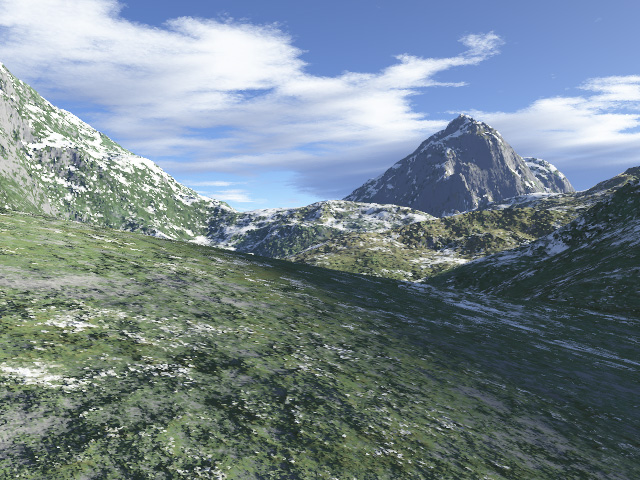
Terragen - Landscape Generator - 2

Terragen - Landscape Generator - 2

What I noticed with the first experiments: you should stick closely to the physical model. So if the camera position is set to 30 meters above the ground, it also looks that way - you should first think about where the viewer is in your scene. In real situations, you rarely hang 30 meters in the air. You should also play a bit with the 3D preview, as it offers a simple way to optimize the viewing angle.

Unfortunately, there are hardly any plugins for OS X - a plugin that simulates a camera lens both in terms of the angle of view and depth of field would be great. But there is only one for Windows.

What is also not so nice - the vegetation is only simulated by colored spots. Just like snow and sand. Some of the people in the gallery images seem to use their own textures or better presets than those provided. So far I have only used the pre-made surface textures. I need to research further how to get better presets that look more realistic - the ones provided always look a bit thin.

Of course, the presets for extraterrestrial scenes are cool - e.g. the atmosphere presets and the surface textures for Mars. You just have to paint a robot in and you have your own NASA mission.

Terragen - Landscape Generator - 1

Terragen - Landscape Generator - 1

Terragen - Landscape Generator - 1