frozen waves - wow!
fotografie - 13.11.2005 - 25.1.2007
soviet roadside bus-stops - fascinating images.
M8, a missed opportunity - ok, thanks Fazal, that saves me a lot of pondering (and a lot of money). Since Fazal thinks about photography in many ways similar to me, it's very practical when he does a "test" of equipment that would also suit me ...
Croatia - Plitvicka Jezera National Park - waterfalls, Plitvicka, Croatia - very beautiful nature photographs.
Light Zone - interesting tool for image editing. Not too expensive, demo available, in Java (and actually portable across multiple platforms). Sounds at least interesting for a test.
Leica M8 Review - 2 second startup time? Hmm. I'll cling to the reason not to buy it ... (for now?)
Paulo Sacramento - creative commons soundtracks and photos - what you see is what you get. And it's good, in a Herbie Hancock style of good.
Leica M8 Hands-on Preview - ok, I am officially in love with the camera. Including the very stylish Tri-Elmar for the digital M. Modern shutter (finally better shutter speeds than the mechanical ones), DNG storage for RAW format, compatible with the M lenses, operation like a classic M - how cool is that?
elektrosmog: Flickragentur - this is how business works. Utilization of images from private users in a print medium. Without paying the photographers. Convenient. Have you already canceled your Flickr account and deleted the pictures?
Bill Biggart's Final Exposures - Images from the WTC attack by a photographer who was killed by debris on that day.
Microsoft acquires iView Multimedia - well, that makes my decision to switch to something else (probably Lightroom) even easier. iView Media Pro was already a shaky affair under the original manufacturer, and then adding Microsoft's "expertise" on top of that ...
Sony: 10-Megapixel camera with a duster from the alpha series - not so stupid, what Sony has made from Minolta.
Digital rangefinder camera Epson R-D1s is coming - and doesn't sound bad at all, the price has come down significantly. So I will probably postpone any camera purchases until after Photokina.
World Press Photos 2005: Germany Premiere in Hamburg - and starting this Saturday, I'll be in Hamburg for a few days.
Mamiya to sell camera division - and the next old name in photography is sold off
UFRaw - a free raw converter based on DCRaw and LittleCMS. Sounds quite interesting.
More Pictures from the DMC-L1
More pictures of the Panasonic Lumix DMC-L1 - the one with the Leica 4/3 lens. This will definitely be one of the things I'll get my hands on at Photokina. Fortunately, it's still a long time until Photokina, so I can put all photo purchases on ice for now. Maybe I'll forget about it by then ... (yeah, and pigs can fly ...)
Digi-Wonder-Chip by TI?
A lot of marketing hype and loud noise, but if only a small part of TI's announcement of a new camera chip is true, that would be very interesting. In principle - at least that's how I read the announcement - it's a DSP specifically for photographic applications. TI is quite ahead in the field of DSPs and custom chips, so there might really be something to it. Let's see what remains of the promises when the first cameras with the part come out.
Leica and Panasonic with Digi-SLR Combo
It was clear to me that after Zeiss entered the market with the ZF lenses and Nikon with the D200, I considered switching to Nikon. And now Leica is also in the mix, announcing the Leica D 14-50 mm F2.8-F3.5 for the four-thirds system. This not only brings the newly announced Panasonic Digi-SLR into play (which is likely based on the Olympus E330), but also the entire Olympus system. So another possible choice when switching? Especially since there are quite usable adapters for Contax-Yashica for the Four-Thirds system, so that I can probably continue to use all Zeiss lenses - unlike with Canon. Interesting is then also the image stabilizer and - probably inherited from the Olympus system - the ultrasonic chip cleaner in the body.
Nikon D200 Full Review
Now at DPreview there is the complete review of the Nikon D200. When I look at the technical data and especially the measurements, Nikon has definitely landed a top device. In my opinion, this absolutely competes with the Canon devices. And when I also look at this cute macro from Nikon, it warms my heart - a 2.8 aperture, 150-degree angle of view with image stabilizer - that would definitely be something fine. Then, combined with the Zeiss lenses for Nikon F and the Katz Eye focusing screens (which do not change the displays in the viewfinder on the Nikon - unlike Canon cameras - and also do not cause a strong change in exposure measurement), this could almost mean photographic nirvana for me. Especially since the camera felt very good in my hand when I last held it at the photographer of least suspicion.
Ok, now I just have to figure out which lenses for the Nikon bayonet really have a usable bokeh - because what I have seen so far in the Nikon environment was not very convincing. Ok, the Zeiss lenses should be pretty great (I already have them for my Contax RTS III), but a few AF lenses would be nice. The macro would of course be at the top of the wish list, as I have learned to appreciate such a macro on my Canon (among other things because of the mercilessly good image quality compared to normal lenses).
In addition, I then have to find someone who buys my Canon equipment at an acceptable rate, or alternatively win the lottery or rob a bank ...
But it's strange, this is the first time a Nikon camera really triggers a "want to have" reflex - Nikon has never achieved that before, at most a "would be nice to have" effect was observable. And those who know me know that I hardly shy away from anything if the incentive is great enough.
screen4DSLR : Changing Focusing screen for Canon DSLR - another provider for replacement focusing screens for digital SLRs (not just Canon!). This one has lower prices (probably because it uses standard focusing screens and just cuts them to size).
Interesting Hybrid from Olympus
Olympus introduces a SLR camera with preview image - either via an auxiliary CCD with AF support or with mirror lock-up via the main CCD. The latter, in my opinion, manufacturers could have installed for a long time - because for macro photography it would be a real blessing if you could get preview images with the normal chip for the first settings.
Sinar m
What happens when Sinar develops a flexible camera system. Okay, they really know what flexible means at Sinar - but one could almost think that they overdid it a bit with the Sinar M.
I'd like to play with something like that, but I think I don't want to know the price for a complete system with AF mirror adapter, a lens, and digital back.
The Scanner Photography Project
The idea itself is not that new - I've already heard people in d.r.f. pondering over flatbed scanners behind GF cameras. But unlike some of them, this person not only carried out the project but also brought it almost to perfection (as far as the image result is concerned). Very interesting effects through the mixing of the scanner movement and object movement. And the digital camera also has a gigantic resolution.
And the next one leaves us
The next photo manufacturer leaves the industry: Konica Minolta gives up traditional camera and film business:
How much and which individual parts of the camera business go to Sony and at what price, the company did not announce in detail, in any case Sony is to continue the business with digital SLR cameras from Konica Minolta. According to Konica Minolta, Sony wants to develop further digital SLRs with which users of the Maxxum/Dynax lens system can continue to use the lenses.
Too bad. The digital Minoltas were actually a comeback - and the Dynax 7D was quite an interesting camera. But soon it will probably be a Sony 7D. Ok, Sony can certainly do photography, but still it's a shame about the name Minolta, somehow it belonged to photography for me (even if I myself was never a Minoltheke).
Cosina is the new Contax, sort of
Clear statement from Zeiss - now with the ZF system. Cosina takes on the role of Kyocera - including the production of Zeiss lenses. And parallel to ZF, there will also be ZS - M42 lenses. However, the use of M42 lenses on Canon EOS cameras is quite boring, as there is no aperture function. With ZF, the full status of manual Nikon lenses should hopefully be supported.
Hmm. I think I need to take a look at the D200 with a manual lens to see if it's possible to achieve usable focusing. With the EOS, it simply doesn't work - at least not with the 10D or 20D, as these do not allow changing the focusing screens and the AF indicator does not work with lenses connected via adapter. On the tiny focusing screens of the AF-digitals, you can't focus by focusing screen at all - completely unusable for critical situations, where focusing estimation by scale is still more precise ...
Actually, this would be exactly my dream system - a solid, robust camera with decent focusing aid, something around 8 MP in the chip and in front of it the Zeiss lenses that I like very much.
Katz Eye Focusing Screen for the Canon 10D @ KatzEyeOptics.com - Replacement focusing screen for the EOS 10D with split-image indicator and microprisms and - optionally - composition lines. Fished from my comments - thanks, Wolf. The focusing screens are also available for other camera types. Unfortunately, the AF point illuminations no longer work with the EOS, so suboptimal for mixed use.
Colorful
Farbenfroh

I already had this image on hugoesk.de (the site no longer exists), but I converted it with Lightroom. The uploaded image (just click on the image itself, then it appears) is a 90% JPEG from the RAW image with simple post-processing using Lightsource.
Adobe Lightroom Beta: Digital Photography Review - Adobe's answer to Apple's Aperture? In any case, there's a public beta - so give it a try.
Lightroom - first tests
I downloaded the public beta of Lightroom from Adobe and tried it out. Wow. I must say, I'm thrilled. This post provides my first impression of this software. Although I can already say upfront: due to the freely accessible beta, every digital SLR owner with a Mac should get this and take it for a test drive.
The most important thing for me: the software is usable even on a Mac Mini - although some actions are a bit slower than one might wish, on the other hand, one must consider that RAW images are edited live.
What I like right away: you can hide window frames and menus, dim the controls, and fully concentrate on the image content. There are also a number of tools that make a very good first impression - I was particularly impressed by the grayscale mixer, with which you can easily adjust the contrast distribution to the different color ranges. Much simpler than with the channel mixer in Photoshop. It's a shame that you can't set the desired mode for the display in the settings - the program always starts with the standard layout.
Nevertheless, the whole program gives the impression in many places that someone has finally dealt with the sometimes quite unpleasant usability of Photoshop. For example, adjusting highlights and shadows is much easier without immediately risking ruining the image result. The histogram is finally worth its name and provides prompt and meaningful information about changes (and it doesn't lie as much as the histogram in Aperture).
The browser for the image collections is quite decent - the features of iView Media Pro are partly more complete, but Lightroom is already much better than using the browser from Photoshop or some other rather simple tool (e.g., the Mac version of ACDSee) to access the images. However, the keyword assignment is still quite meager - you create a new keyword without completion or similar, and then assign it to one or more images by drag-and-drop. iView Media Pro can really offer much more here. In addition, no number of assigned images is displayed next to keywords, although numbers are displayed everywhere else.
The choice is definitely nice when importing images: you can index folders that remain in their old place, or move or copy images to a central image storage (and thus immediately create a backup). And the really nice thing: when transferring to the central storage, you can immediately convert the images to DNG, so you get rid of the manufacturer-specific formats - but without loss of information. And you can mix it all well - you can leave some images on external drives or also move them to the central storage. It's a shame, however, that you can't move the images between the storages via Lightroom - an image that lies somewhere should better stay there, otherwise Lightroom looks stupid.
The speed is not only okay when editing; importing and exporting also takes place at a decent speed. However, you should consider the memory requirements - on a Mac Mini, it makes sense to close other programs to use the memory, which is quite scarce with 1 GB, completely for Lightroom. It will thank you!
Of course, some things are still missing - it is, after all, a beta. What I spontaneously missed: there is no tool with which you could extract sections from the image. But that will certainly come. It would also be very nice if Lightroom got a downsizing/upsizing function with which you could convert images to print formats in a qualitatively usable way. With that, Lightroom could potentially replace iView Media Pro, Raw Developer, and Size Fixer for me.
In any case, it is a tough competition for Aperture and iView Media Pro - therefore, it is to be expected that there will finally be a bit more movement in the image management specifically for photographers. The only question remains: what will the fun cost when it is available as a product at the end of the year. And how the betas will develop in the meantime.
PictureSync » Photo-sharing for Mac OS X - Batch upload of images to various services. Could be quite interesting if you could also define new services - e.g. for my own sites.
RAW Developer Upgrade
I've already drummed up some support for the RAW Developer from Iridient Digital - back then it was still version 1.2. The new version has definitely become much more rounded and I really like it during my first tests. And even if it's not the fastest converter - it's definitely one of the most powerful. Together with a good image browser like iView Media Pro, it's definitely a more cost-effective and resource-saving alternative to Aperture.
Leica Digital M
And while we're on the topic of Speculoos (which also fits the season): Leica wants to build a Digital M. There have been rumors and considerations for a long time, but this is quite concrete in the LFI. Sounds very good - a digital M-body would definitely be something I would find exciting. However, I will probably find the price of a digital M less exciting, so I should just keep buying film until I have saved enough from the film material to cover the price of a digital M, which would probably take a few centuries.
New 35mm Optics from Zeiss
Soon there will probably really be Zeiss lenses for Nikon - the images certainly don't look like fakes. Okay, on January 18th we will know for sure, but it already looks very likely that Nikon will become the new Contax. Maybe there will also be optics with Canon adapters in the long run. On the other hand, I am very satisfied with my Canon macros and at least in that area I have nothing to complain about. Nevertheless, some of the Zeiss lenses on a digital camera would of course be quite nice - especially if they are well integrated (the adapter solutions for Canon are unfortunately only suboptimal).
Apple Aperture Review - or: Beware of Version 1.0 | The Voice of the Free World - found in my comments (originally on the old site) a scathing review of Apple Aperture. The article is in German and very interesting, as it is written from the perspective of a regular user.
Aperture at Ars Technica
Ars Technica tests Aperture - and is less impressed by the program than by the size of Apple's manhood:
Jumping headfirst into the fully mature digital imaging market requires the shameless bravado of a one-legged man at a butt-kicking contest or any number of contestants on So You Think You Can Dance?
That's quite a vivid expression.
Based on the description, I'll stick with iView MediaPro - it runs well on old machines and does almost everything Aperture does. And where it doesn't, external programs do. And I still find Aperture's system requirements obscene.
Light Field Photography with a Hand-Held Plenoptic Camera - I only understand half of it, but even that sounds really good. A camera that doesn't just capture pixels but layers of pixels - and then the focus point can be set afterwards via software. The site has some examples. For macro photography, the technology would be absolutely amazing ...
A Millimeter
A Millimeter
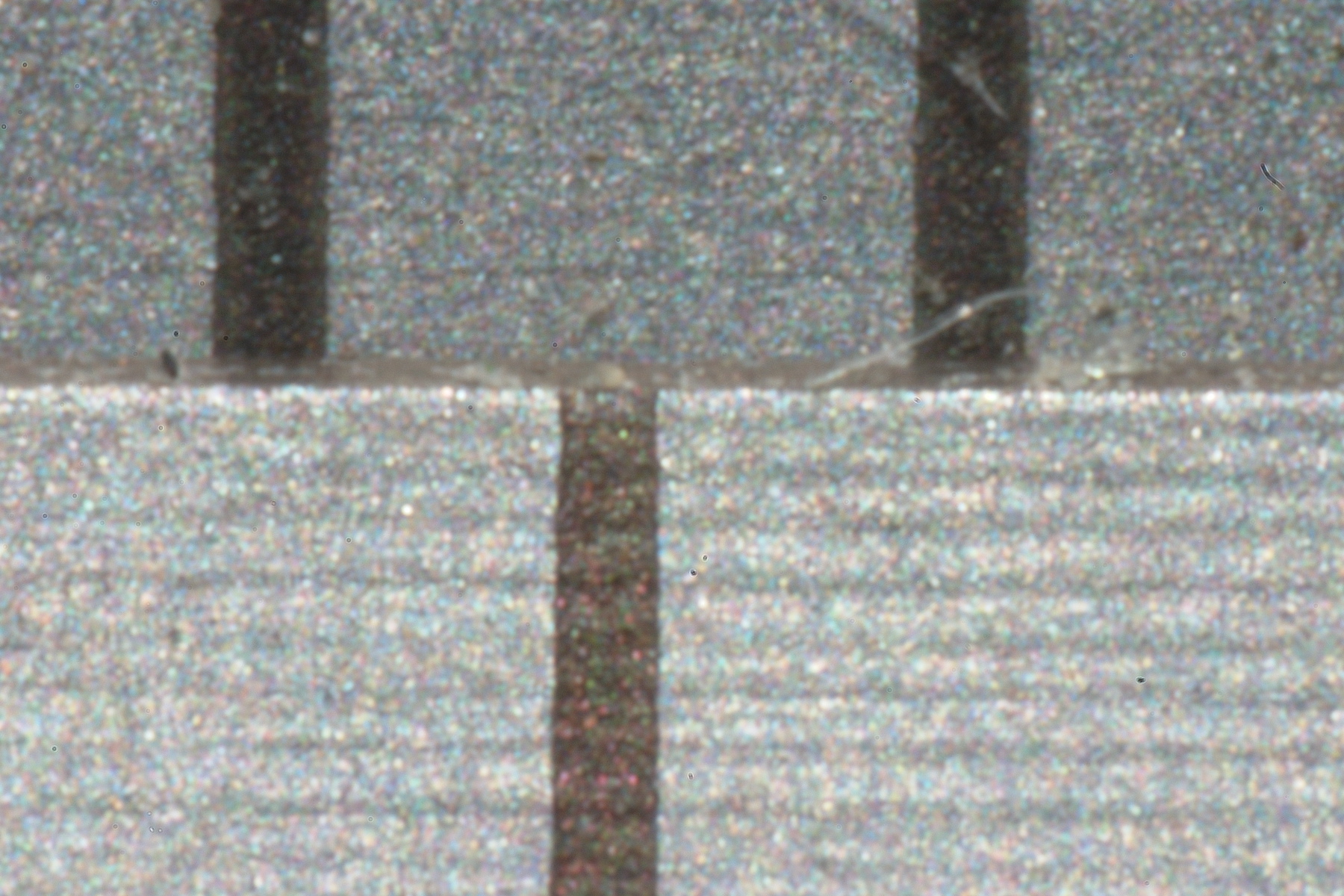
The whole thing is really just a millimeter - more precisely, the centers of the two upper lines are one millimeter apart. The lower line is on the half millimeter. The blur is completely normal with the shallow depth of field that you have at such extreme magnification scales - 12x magnification relative to the camera chip of the EOS 10D.

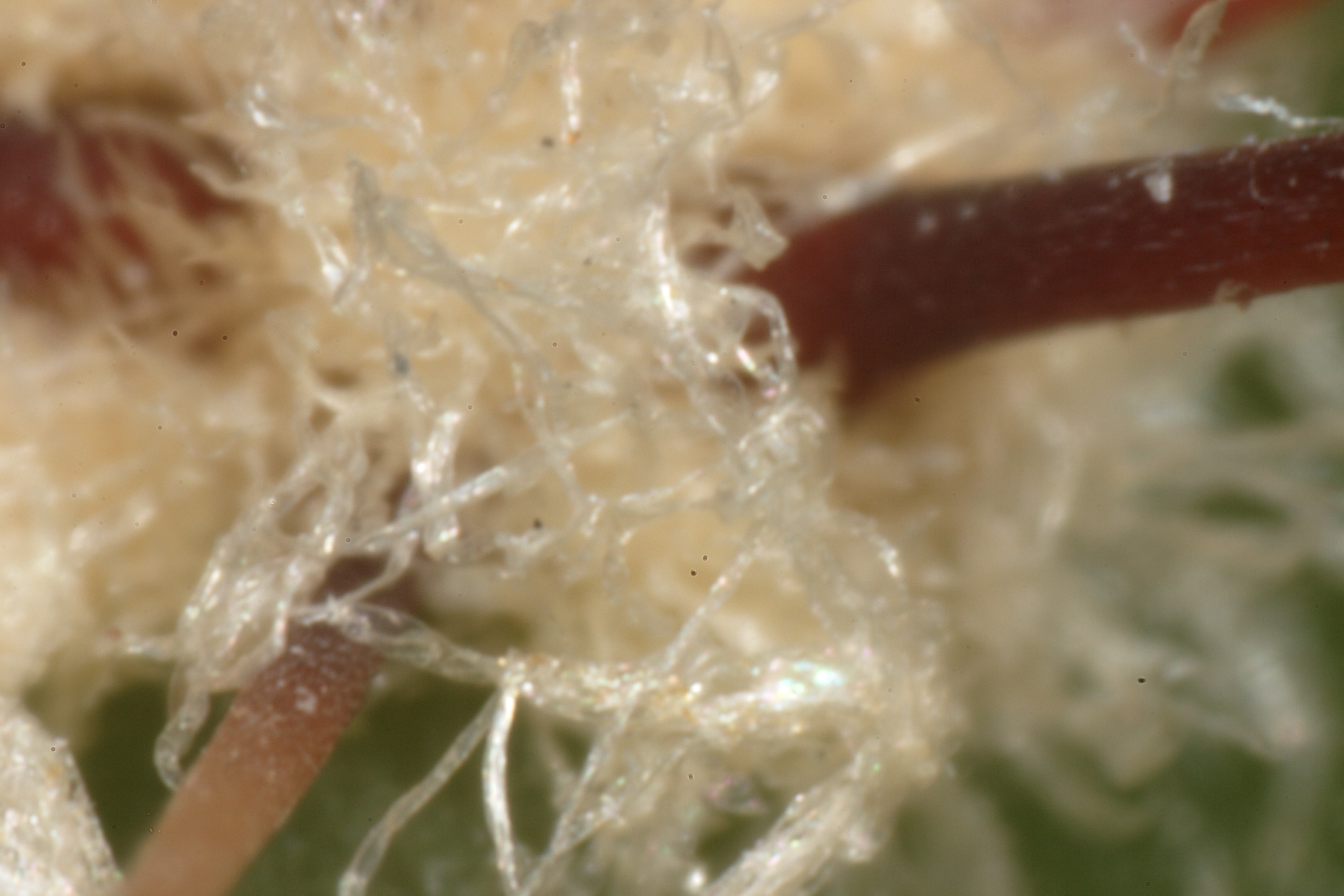
Cactus Mite Revisited
Jutta and I have been playing around with macro photography again - Jutta has acquired a Zeiss cold light source, so there's finally enough light even for absolutely crazy magnifications. Result: the cactus mite visited again:
If you want a size comparison: the following image is a section of a fairly precise millimeter scale - the top two lines are one millimeter apart, the bottom one is on the half millimeter. The image field corresponds to that of the image above.
The slight blurriness comes from the extreme magnification ratio - about 12x magnification relative to the base area of the 10D chip - and from the optical system operated far outside its optical parameters.
The equipment used was a Canon EOS 10D, a Canon EF to Contax Y/C adapter, a Contax bellows unit, a Tokina ATX 17mm/f3.5 in retro position, and the whole thing then on a tripod and ball head (such an Arca Swiss Monoball is already something fine - the ideal ball head for macro work). Then some finesse, patience, and series shots with minimally changing distance between lens and subject.
Taking Photos While Geocaching
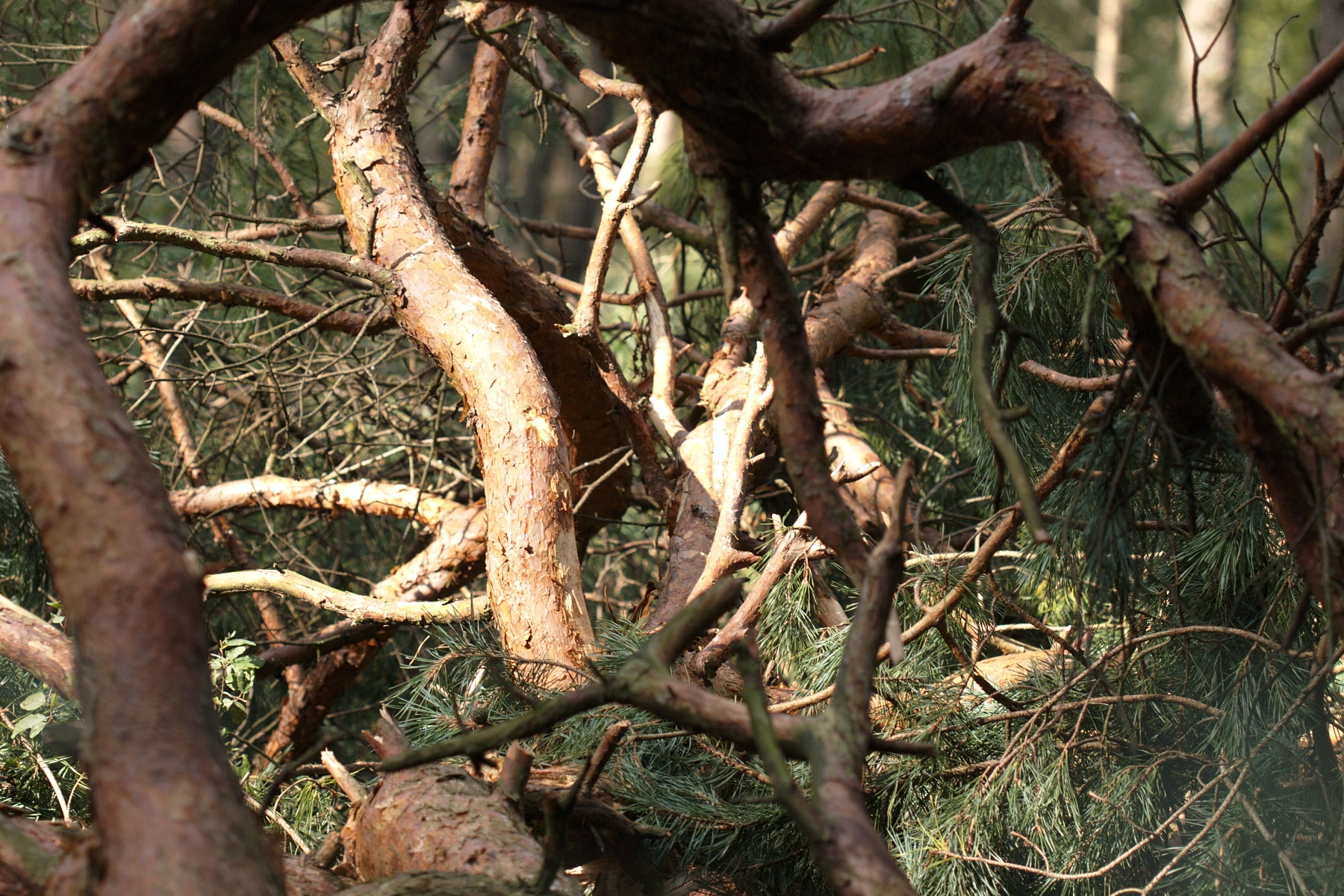
A series of pictures taken during various geocaching tours. Some in the Coesfelder Heide, some near Wolbeck: