Big Damn Stupid - no, Blogging Desktop Server. Currently my favorite project where I play around with Vibe-Coding and build software with which I can run the blog. But this time with the clear perspective that I won't succumb to bit rot or the complexity spiral again. Simple software with a usable interface for maintaining blog posts, but storage as Markdown files with YAML front matter to be easily stable for the future. Then with sqlite for caching and full-text search and other comfort features and git for synchronizing the blog data, and git-lfs for the images. Feels quite usable right now.
blogging
Blogofile - I stumbled upon this while considering what to do. One of the many static blog engines in Python with Git integration. Could potentially be interesting for smaller sites (or e.g. for a metablog).
Learning from Dave Winer - ok, only when it comes to blog comments. And yes, I have also drastically changed my format by using the link component much more strongly instead of the page component (pages automatically have comments for me, links do not). If I write longer texts, I might want comments. If I just point somewhere, rather not.
MarsEdit - can also preview Markdown. Might be interesting for me, as I like to base my projects on Markdown.
Blogs with Link Redirector have stupid ears
Decided that blogs (and webpages) that deface outgoing links through a redirector for the purpose of (potential) evaluation of visitor off-clicks are stupid. And therefore unsubscribed from some of those blogs. Even if the content is interesting - if I have to register the clicks on further information with the blog owner first, they can kiss my RSS feed.
Yes, there are sometimes technical reasons why one might want to do this - my link postings have their own GUID, but they are redirects to the original (since I only have a short comment there, which was already included in the RSS feed). But as a general measure? No.
Cute from the blogosphere - sometimes I just have to link to such meta-internal discussions. Because of the humor value.
4 years of blogging - even a bit more. Because I always forget when my first post was. Well, it's not really that important ...
Owl Content
Owl Content has been around for quite some time now. It just runs alongside, doesn't make much of a mess, and simply does its thing. And it has now collected over 2300 articles! I just wanted to mention that. And for those who are now wondering what it is - surf over there. Read. Maybe even contribute yourself?
StudiVZ - The Hitler Screenshot and the Buyer Facebook - hey, hello toilet, here arm of fool. Or something like that. Up to the shoulder.
Even at Bildblog, milkmaids are doing the math - yeah, that bothered me too. This silly Eschonda argument. Cars just fall from the sky and are given to people or something ...
David Byrne(yes, the one from Talking Heads) blogged. Among other things, against American Christianist madness.
Backfire for Transparency International
In response to the demands of Transparency International, Udo Vetter from Law Blog certifies the lawyer of the association a disturbed relationship to freedom of the press and freedom of opinion. With something like this, one would almost wish for an RSS feed for a possible court hearing to take place.
Transparency International does not like criticism and sends the lawyer
Transparency International doesn't like criticism and sends in the lawyer - an employee was fired, the circumstances seem a bit rude on the company's part. A blogger reports on this. And the lawyer from Transparency International pulls out the big stick. Well, ix has a fitting compilation of further facts about this NGO. Everyone reads for themselves and judges for themselves what to make of it.
Only one thing should TI have considered: if the main goal is to present oneself and one's members as pioneers against corruption (why just present oneself? Why not be?), then one should not make such blunders at the same time. Because otherwise, one presents oneself as something quite different in the long run ...
Freedom of opinion à la Euroweb
No idea what other services Euroweb Internet GmbH uses to make money, but publicity stunts should not be one of them, as they are currently reaching new lows with their approach to dealing with unfavorable criticism. Somehow, I don't understand such companies and their lawyers. On the one hand, it is constantly being said that the internet is not a lawless space - but through the massive approach and the potentially high costs, such actions make the internet de facto exactly that lawless space. And from the political side, there are at best drafts to escalate the whole situation, instead of providing useful tools against obvious excesses such as mass cease and desist letters. Or even considering to what extent the means of cease and desist against privately operated websites make sense at all, or whether the means of cease and desist should not be focused much more strongly.
Dave Winer Breakdown
Somewhere it was to be expected, nevertheless the way Dave Winer is now completely nuts is pretty rare even for him. I mean, with Rogers Cadenhead he had someone who, despite all his troublemaking (especially around the RSS Advisory Board), tried to make him look somewhat good. Well, that's over now. Dave Winer is just the prototype of an internet sociopath. Shitty Software. Shitty Manners.
NPB-BLOG - no, not a blog of the NPD, but a blog about NPD activities.
P.K.K. - Purzel-Kollektiv Kübelreiter - I find purzeln cute.
To the Content Thieves
Once again, as described at Blogbar, there are content thieves around. Here's a preventive explanation of what a CC license with Share-Alike condition and Non-Commercial means: no ads on the pages. No commercial site - for example, paid accounts or similar. And yes, I mean Non-Commercial seriously. Share-Alike also has a simple explanation: a site that reproduces my content must be under the same license as my site.
Those who cannot meet the two conditions (we won't talk about the explanation of Attribution) will have to ask. And this does not mean that a lack of response is a silent consent - those who do not have explicit permission from me and cannot comply with the CC license must keep their hands off my content.
And those who think I can't do anything to them: those who are stupid enough to automatically pull content from RSS feeds should consider that the pulling machine is recognizable (especially for "stationary" services) - and that appropriate feeds can be provided for individual servers if you program your software like I do. And believe me, dear content thieves: the content you would then pull would definitely not please you.
Kids ...
My image blog hugoesk.de (meanwhile deactivated again) seems to be enjoying great popularity lately - various images have appeared as background graphics on myspace.com and xanga.com sites. It's kind of strange to owe several GB of transfer volume (about ten times the traffic my main blog has) to some kids... (and I haven't even written anything about Tokio Hotel).
Well, so educational measures have been activated again (and no, the image used is neither obscene nor offensive - just a polite request):
# Deeplinking von http://www.xanga.com/
RewriteCond %{REQUEST_FILENAME} ^.*\.jpg$
RewriteCond %{HTTP_REFERER} ^http://www\.xanga\.com/.*$
RewriteRule .* /wp-images/bilderklau.jpeg [L]

# Deeplinking von http://www.myspace.com/
RewriteCond %{REQUEST_FILENAME} ^.*\.jpg$
RewriteCond %{HTTP_REFERER} ^http://.*\.myspace\.com/.*$
RewriteRule .* /wp-images/bilderklau.jpeg [L]
Of course, my images are all under a CC license, so they can take them if they want. But that doesn't mean my traffic and my computer resources are also under a CC license - and especially with full-size JPGs, that's quite a bit of volume and computer resources. One should at least follow the forms (e.g. ask first if you can't handle the traffic yourself).
A single image in January with 3500 and this month already with 1500 hits has easily consumed several GB of volume - and these are only two sites that link to it. They seem to have a really big (and online-active) circle of friends, those two girls.
And backlinks (which would have been the minimum according to the CC license I use) they naturally haven't set either...
One feels somewhat abused ...
... if the monthly traffic statistics show 1.79 GB for normal visitors, but 1.83 GB for bots and stuff. And if you then realize that 1 GB alone was wasted on the Google bot, 0.5 GB on Inktomi and still 125 MB on the MSN bot. Somehow it seems that the whole internet is mainly read by bots, not by humans: bots had 235071 page views, humans only 114158 page views.
If there is ever a Terminator, it will probably be controlled by an internet search engine ...
Domain-Engel becomes cheeky
When alleged domain angels threaten blog hosts with a lawyer, there's usually a sorehead behind it. In this case, it's probably a bird unknown to me so far, but who has apparently already been noticed before - and this time wants to get at Lanu (from DotComTod and BooCompany) presumably because of their postings about him - and, due to the lack of an imprint, now thinks he can force Dirk Olbertz (the one from blogger.de) to disclose the data.
It will certainly be exciting to see what happens next - another attempt to suppress opinions with a lawyer. Whether the noise spreading through the blogs will improve his already spoiled reputation of the domain grabber again is rather questionable.
But when you then see that a legal counsel is also involved, nothing surprises you anymore.
Jean-Remy von Matt unnerved - envious for that
It's quite amusing when an alleged communications professional lets his envy show so clearly:
Many of you write that I scored an own goal with my email. Okay, maybe one. But how many own goals are you scoring right now by picking up my buzzword "Toilet Walls of the Internet" in part indignantly, in part gleefully, spreading it in the sense of agenda setting? At Technorati.com, the search term was temporarily ranked 3rd!
Well, that's just the way it is - there are also others who can exploit a term. And in the blogs, the toilet wall is simply more popular than the you-are-German-language nonsense.
And about the alleged "apology" - sorry, but that is an apology that you can also read from politicians - meaningless, vague, and the only statement you can derive from it at best is a defiant "but I'm right!" Tja, Marketinghansel. Big mouth up front, but only a sensitive soul and no clue behind it.
Feeds on this server
Here are a few notes about feeds on this box - some of you might not have noticed what my software can do:
- Every search, every collection, and every overview page - i.e., lists of tagged posts, search results, homepage, link dump, photo blog - has its own RSS feed.
- The appropriate RSS feed is always embedded in the link tags, but also accessible at the bottom of the image with the small XML icon.
- Media files include the media file as an enclosure - so to speak, integrated podcasting (if I were to do it) and photocasting (which should theoretically please iPhoto 06 users).
- Tag pages can actually activate multiple tags: simply separate the tags with a + in the URL. This way, you can also subscribe to a specific topic.
- The results of Zeitgeistgeklicke - i.e., the compilation of content types and tags - simply provide a search, hence also a separate feed for this.
- Comments are not only found on the articles but also via the forum. And of course, they also have their own feed.
By the way, I recently also linked the link dump and the photo blog directly at the top of the menu - so if you want to see the current (and older) images, just click there. Unfortunately, the calendar is not yet synchronized everywhere with the displayed content - only the lists of tagged posts and the comments already correctly show only the days in the calendar for which there is a correspondingly tagged post or a comment. For the others, the calendar is still displayed as on the main page.
Blog Move
Well, here it is - I'm finally moving my weblog here to the new software - no more PHP for my main blog. Right now, both systems are running separately, I'm just synchronizing the content to the new blog. In the next few days, however, I will install a redirector here that redirects all important URLs to the new system. Most comments are transferred, only the comments on blogmarks are lost, the new software no longer has a separate page for links where comments could be placed - it doesn't make sense anyway, anyone who wants to discuss the links should use the contact options of the linked page.
Otherwise, the new system is of course completely created with Django - finally everything in Python. That was also the main reason. Moreover, the ever-increasing PageRank, all the many links and the - for my expectations huge - traffic became increasingly unsettling, something had to be done about that. And the simplest solution is still to change the domain.
Oh, by the way, feeds are also redirected, but if you want, you can already subscribe to the new feed at the new address.
If you notice anything about the new system, either write here or over there in the comments (where it then works). I have tested almost everything, but errors still creep in from time to time ...
Trolls in comments - failed the intelligence test
How cute. I have this little question game against spam on my site. And I personally find the questions to be exceptionally simple. Downright banal, so to speak. Not worth mentioning, really.
Well, now the question arises as to how the brilliant comment with the text "You are so stupid" could come about - and with the text added by my system that the corresponding commentator gave the wrong answer to my little question game.

Cute, really cute.
Definition: Embarrassing
People who write longer articles about their blog design.
Dream Dancer at Work
Who wants to have a good laugh: RatcliffeBlog—Mitch's Open Notebook: Measuring podcasts: The right first step - about the pathetic attempts of Audible to make money from podcasts. Regardless of what you think about podcasts (I don't think much of them, their accessibility is simply terrible), Audible's ideas (which sell DRM-infested audiobooks) are simply laughable.
Akismet - Centralized Anti-Spam Filter
Photomatt (from WordPress) has built a central anti-spam service called Akismet that can be used with WordPress via a plugin. Additionally, there is an API that allows other services to be integrated. Basically a good idea - even though I generally have an aversion to central services, unless I myself operate these central services.
What really bothers me, however, is this small excerpt from the FAQ:
Well without giving too much of the secret sauce away, we can safely say that it would be pretty difficult to poison Akismet.
So central service - okay. I don't like it, but it certainly makes sense for others who cannot or do not want to operate such a service themselves. But "secret sauce" - I should send my comments with the personal data of my commenters to a foreign system, where I can't even see the software running behind it? Sorry, no thanks.
to flock - to gather
I don't know if the above is the right motto for me. Bookmarks in del.icio.us. Pictures in Flickr. Somehow, I prefer to have this stuff with me rather than with some central hosts.
What they do right: automatic indexing of page content, so you can find it again. If there were also an OS X version where the browser is really an OS X application (and not just an application that runs on OS X), that could really be appealing.
Desktruktive?
Got a question for those who feel the need to accuse my blog of being destructive: could you idiots please tell me why I should be constructive when dealing with the nonsense that politicians, media, and the economy are peddling? If someone takes a dump in your front yard, you probably take it quite constructively as rose fertilizer, right? Dreamers.
Blogcounter, Penis Size Comparisons, and Other Lies
Right now, people are once again wildly discussing hit counts and similar nonsense. Usually, I don't care about these (my server has an absurdly high free allowance that I can never use, and the server load is also low - so why should I care how much comes in?), but with the various announcements of hit counts, page views, and visits, I always have to smile a little.
Just as a small analysis of the whole story. First, the most important part: where do these numbers come from? Basically, there are two possibilities. One relies on the fact that pages contain a small element (e.g., an image - sometimes invisible - or a piece of JavaScript or an iframe - all commonly referred to as a web bug (web bug)) that is counted. The other method goes to the log files of the web server and evaluates them. There is a third one, where the individual visitor is identified via a cookie - but this is rather rarely used, except for some rather unpopular advertising systems.
Basically, there are only a few real numbers that such a system can really provide (with the exception of individualization via cookies): on the one hand, hits, on the other hand, megabytes and transfer. Quite remotely useful, there is also the number of different hosts (IP addresses) that have accessed the site.
But these numbers have a problem: they are purely technical. And thus strongly dependent on technology. Hits go up if you have many external elements. Bytes go up if you have many long pages (or large images or ...). IP addresses go down if many visitors are behind proxies. And they go up if you have many ISDN users - because of the dynamic dial-up addresses. Changes in the numbers are therefore due to both changes in visitors and changes in the pages.
All these numbers are as meaningful as the coffee grounds in the morning cup. That's why people derive other numbers from these - at least technically defined - numbers, which are supposed to say something. Here, the visits (visits to the website), the page impressions (accesses to real page addresses), and the visitors (different visitors) are to be mentioned.
Let's take the simplest number, which at least has a rudimentary connection to the real world: page impressions. There are different ways to get there. You can put the aforementioned web bugs on the pages that are to be counted. Thus, the number is about as reliable as the counting system. Unfortunately, the counting systems are absolutely not, but more on that in a moment. The alternative - going through the web server log files - is a bit better. Here, you simply count how many hits with the MIME type text/html (or whatever is used for your own pages) are delivered. You can also count .html - but many pages no longer have this in the addresses, the MIME type is more reliable.
Significance? Well, rather doubtful. Many users are forced through their providers via proxies - but a proxy has the property of helping to avoid hits. If a visitor has retrieved the page, it may (depending on the proxy configuration) be delivered to other visitors from the cache, not fetched from the server. This affects, for example, the entire AOL - the numbers are clearly distorted there. The more A-list-bloggerish the blogger really is, the more distorted the numbers often are (since cache hits can be more frequent than with less visited blogs).
In addition, browsers also do such things - cache pages. Or visitors do something else - reload pages. Proxies repeat some loading process automatically because the first one may not have gone through completely due to timeout - all of these are distortions of the numbers. Nevertheless, page impressions are still at least halfway usable. Unless you use web bugs.
Because web bugs have a general problem: they are not main pages. But embedded objects. Here, browsers often behave even more stubbornly - what is in the cache is displayed from the cache. Why fetch the little picture again? Of course, you can prevent this with suitable headers - nevertheless, it often goes wrong. JavaScript-based techniques completely bypass users without JavaScript (and believe me, there are significantly more of them than is commonly admitted). In the end, web bugs have the same problems as the actual pages, only a few additional, own problems. Why are they still used? Because it is the only way to have your statistics counted on a system other than your own. So indispensable for global length comparisons.
Well, let's leave page impressions and thus the area of rationality. Let's come to visits, and thus closely related to visitors. Visitors are mysterious beings on the web - you only see the accesses, but who it is and whether you know them, that is not visible. All the more important for marketing purposes, because everything that is nonsense and cannot be verified can be wonderfully exploited for marketing.
Visitors are only recognizable to a web browser via the IP of the access, plus the headers that the browser sends. Unfortunately, this is much more than one would like to admit - but (except for the cookie setters with individual user tracking) not enough for unique identification. Because users share IPs - every proxy will be counted as one IP. Users may use something like tor - and thus the IP is often different than the last time. Users share a computer in an Internet café - and thus it is actually not users, but computers that are assigned. There are headers that are set by caches with which assignments can be made - but if the users behind the cache all use only private IP addresses (the 10.x.x.x or 172.x.x.x or 192.168.x.x addresses that you know from relevant literature), this does not help either.
Visitors can still be assigned a bit if the period is short - but over days? Sorry, but in the age of dynamic IP addresses, that doesn't help at all. The visitors of today and those of tomorrow can be the same or different - no idea. Nevertheless, it is proudly announced how many visitors one had in a month. Of course, this no longer has any meaning. Even daily numbers are already strongly changed by dynamic dial-ups (not everyone uses a flat rate and has the same address for 24 hours).
But to add to the madness, not only the visitors are counted (allegedly), but also their visits. Yes, that's really exciting. Because what is a visit? Ok, recognizing a visitor again over a short period of time (with all the problems that proxies and the like bring about, of course) works quite well - and you also know exactly when a visit begins. Namely, with the first access. But when does it end? Because there is no such thing as ending a web visit (a logout). You just go away. Don't come back so quickly (if at all).
Yes, that's when it gets really creative. Do you just take the time intervals of the hits? Or - because visitors always read the content - do you calculate the time interval from when a hit is a new visit from the size of the last retrieved page document? How do you filter out regular refreshes? How do you deal with the above visitor counting problems?
Not at all. You just suck. On the fingers. Then a number comes out. Usually based on a time interval between hits - long pause, new visit. That's just counted. And it's added to a sum. Regardless of the fact that a visit may have been interrupted by a phone call - and therefore two visits were one visit, just with a pause. Regardless of the fact that users share computers or IP addresses - and thus a visit in reality was 10 interwoven visits.
Oh, yes, I know that some software uses the referrer headers of the browser to assign paths through the system and thus build clearer visits. Which of course no longer works smoothly if the user goes back with the back button or enters an address again without a referrer being produced. Or uses a personal firewall that partially filters referrers.
What is really cute is that all these numbers are thrown on the market without clear statements being made. Of course, sometimes it is said which service the numbers were determined via - but what does that say? Can the numbers be faked there? Does the operator count correctly (at blogcounter.de you can certainly fake the numbers in the simplest way) and does he count sensibly at all? Oh well, just take numbers.
The argument is often brought up that although the numbers cannot be compared directly as absolute numbers across counter boundaries, you can compare numbers from the same counter - companies are founded on this, which make money by renting out this coffee ground technology to others and thus realizing the great cross-border rankings. Until someone notices how the counters can be manipulated in a trivial way ...
It gets really cute when the numbers are brought into line with the time axis and things like average dwell time are derived from this and then, in combination with the page size, it is determined how many pages were read and how many were just clicked (based on the usual reading speed, such a thing is actually "evaluated" by some software).
So let's summarize: there is a limited framework of information that you can build on. These are hits (i.e., retrievals from the server), hosts (i.e., retrieving IP addresses), and amounts transferred (summing the bytes from the retrievals). In addition, there are auxiliary information such as e.g. referrers and possibly cookies. All numbers can be manipulated and falsified - and many are actually falsified by common Internet technologies (the most common case being caching proxies).
These rather unreliable numbers are chased through - partly non-public - algorithms and then mumbo jumbo is generated, which is used to show what a cool frood you are and where the towel hangs.
And I'm supposed to participate in such nonsense?
PS: According to the awstats evaluation, the author of this posting had 20,172 visitors, 39,213 visits, 112,034 page views in 224,402 accesses, and pushed 3.9 gigabytes over the line last month - which, as noted above, is completely irrelevant and meaningless, except that he might look for more sensible hobbies.
When Google is already building a new feed reader ...
... why doesn't it support feed autodiscovery then?
weblogs.com sold to Verisign?
If I understand Dave Winer's ramblings correctly, he has sold weblogs.com and other infrastructure to Verisign (yes, confirmation from Verisign).
Which makes weblogs.com completely dead and uninteresting to me, because everything Verisign touches turns to shit. Not to mention I don't trust the company as far as I can spit - they have their dirty fingers in too many internet topics (and are all too concerned about expanding their already absurd monopoly in some areas).
Well, today you ping via Ping-O-Matic anyway - this way pings also go out much broader, also to more sensible services. Apart from that, weblogs.com was already pretty unusable because it simply lacked the necessary performance. Which is no wonder if you choose the wrong software base for such services (nothing against Frontier, but it's simply unusable for this).
this strange survey ...
... which has been circulating through the blogs for a few days, gets its fair share here. It starts harmlessly in the comments with the usual considerations about personal data and where does the email address come from, what are the personalized links for in the "anonymous" survey - so quite normal and healthy behavior from the people.
Then at some point the providers (the Knallgrauen) jump in. And then something comes up that leaves me speechless:
And now a few personal words: I find the excitement here a bit puzzling. We (twoday.net) have always been very careful with data in the past and have always tried to be careful and act in the best interest of the users with such topics. Every day, personal rights are handled much more carelessly elsewhere and no one cares. Here, however, everyone can say how they imagine research, including beautiful publication dreams, which are unfortunately far removed from any reality.
Sorry, but what? So the concerns about the passing on of email addresses for a purpose to which the owner of the address has not explicitly consented are responded to with the flimsy argument "we are always soooo good and the others are soooo bad, and anyway, you are all dreamers"? It's quite astonishing how much arrogance can fit into a small paragraph ...
This casts a not very positive light on the relationship of the Knallgrauen to the protection of the personal data of the users. And no, a survey is nothing that is necessary for the operation - no matter how flimsy the justification with which it is pulled out by the hair.
And it was not just a slip of the tongue, as another comment from the Knallgrau direction further down proves:
in other discussions I can personally not understand the excitement about some things. Data protection is important, but not all boys are bad. So I am probably not to be counted among the cautious species, maybe I have just been lucky so far.
Yeah, yeah, data protection is always taken too seriously. Sorry, Knallgrau, but data protection is always taken too lightly, which is why such idiots like you just brush it aside. It's much more important to carry out a survey that has been planned for months (from which the visitor has nothing, but only the evaluator and the recipient of the result - just by the way) and not to cancel it because of such trivialities, as you write in the same comment:
the interesting thing about communication is that there is always too little of it. The sensitive environment (due to previous surveys) was clear to us, the survey has been planned and prepared for months (very thoroughly prepared) and we did not want to cancel the project for such reasons.
Exactly. Screw data protection concerns, they are just "such reasons" and nothing important, like, for example, another insignificant survey about the blogosphere (in which the visitor is asked about their income to improve the provider's services - ah yes) ...
Google's Blog Search Stupid
When will Google finally realize that searching for links to a blog is pretty stupid if it returns links from the blog to itself in the results? I know that I link to myself - I don't need Google for that. Neither the web search nor the blog search. And of course, you can't just use -site or -domain or something like that. Rarely stupid. It already annoyed me with the normal Google web search, and it's also annoying in the blog search. A search for link: is a search for external links, so please filter the results to exclude the site itself ...
Drowsy Question Game Activated
Because spammers are bombarding my server again and I don't feel like seeing a ton of spam in the moderation queue, I've activated wp-questionnaire. For now, there's a more or less silly question that needs to be answered for a comment to appear on the pages. Sorry, it's unfortunately necessary at the moment - it's about 30-40 spam comments per day. Yes, they only end up in moderation, but it's still simply annoying.
Once the situation with the spammers has calmed down, I'll probably turn it off again. If anyone notices anything strange regarding the comment function, just let me know (but better via the feedback page and not via the comments).
Further Spam Fallout - No More Trackback and Pingback for Me
As a further action due to the ongoing spam wave, I have disabled trackbacks and pingbacks on my site. I never really liked trackbacks anyway - the technical concept is ridiculous. Pingbacks are technically better implemented - due to the stronger focus on backlinking - but they are visually just awful: the technically generated excerpts just look like shit.
If someone wants to comment, they can comment - and a comment can also contain a backlink. And for everything else, there are the usual curiosity tools - and their link search works quite well (although I have also found mountains of link spam there - some stupid spammer pseudo-blog had a bunch of links to me for a while and ended up in my Technorati evaluations).
Since I am consistent, I will also no longer send out trackbacks and pingbacks if I don't accept them myself. Sorry, but my time is too precious to manually clean up garbage from a technically unfinished protocol ...
Google Blog Search
Google now also has a Google Blog Search - but why does someone who enters the race last have to be so stupid (arrogant?) to deliver this blog search only as HTML and not also alternatively as its own RSS, so that you can do something with the search results? I mean, a performant alternative to Technorati or Feedster would be quite nice, they are simply down too often. But what's the point if I have to do all the searches myself and manually?
Correction: there are XML links for the search results.

Dave's new OPML editor with blog
I'm currently playing around with Dave Winer's OPML Editor, which he now uses for his blog. It looks quite fun and has a lot of features. My OPML Blog has collected some of the insights I've gained from it. I certainly won't switch over just like that - that would be Quark, which is not necessarily my target software. But it's fun to play with something completely different again.
Unfortunately, the OPML Editor has inherited some of the ailments of Radio Userland and Frontier, especially the handling of umlauts is not really smooth (I would like to have consistent UTF-8 support finally) and the runtime behavior is better than in Radio, but it still occasionally consumes too much CPU.
The concept of rendered outlines does have a certain charm. However, many parts of the rendering are not really accessible to normal users - you can edit the ancient table layout and make something else out of it, but the OPMLs are implemented with the internal OPML renderer and the HTML fragments are not so easy to change - and thus, for example, changing the language is quite cumbersome, as is the complete removal of layout tables.
More will certainly appear on the OPML blog from time to time, here I will write at most a few conclusions.
Another Questionnaire
From Lisa Sonnabend's mailbox:
As part of my thesis at the Institute for Communication Studies and Media Research at Ludwig-Maximilians-Universität München, I am conducting a survey among weblog readers on the topic of "Credibility of Weblogs". This is one of the first scientific studies on the phenomenon of weblogs in Germany.
It is to be clarified whether weblogs are already considered as trustworthy and competent in certain points such as fairness or impartiality as traditional media – and in which points there are great differences. In addition, the survey examines which special qualities weblogs have from the perspective of the recipients and what importance they have for the users. Based on the results, a prognosis about the future importance of weblogs in the media landscape is to be made.
And I should put the link in the blog so that people can participate. Well, I'll do that, even though I wonder what competence and credibility the old media are supposed to have.
The diaries of Franz Kafka, 1910-1923
I am neither the first nor the most original person to write about Franz Kafka blogged. But no matter how late I jump on the bandwagon, this is a blog that you really should read. And even a Megawattworm couldn't find anything to criticize about its intelligence.
Webspammer with new tricks?
It seems like web spammers are learning a few new tricks. In any case, I stumbled upon links to myself that come from a WordPress blog consisting only of wild HTML snippets that seem to have been created due to searches for "house" - and then in the blogroll of the blog are various typical junk sites. So it could be that spammers are now building pseudo-sites with links and content that are supposed to flood the search indexes of systems like Technorati or the ping services.
Oh, and the Texas-Holdem guys have also learned a few new tricks - the URLs now have more changing server names and file names so that normal keyword filters no longer work quite as well and I am more often presented with spam for moderation - for a long time the stuff went directly into the trash because the guys were really too stupid ...
Annoying bunch.

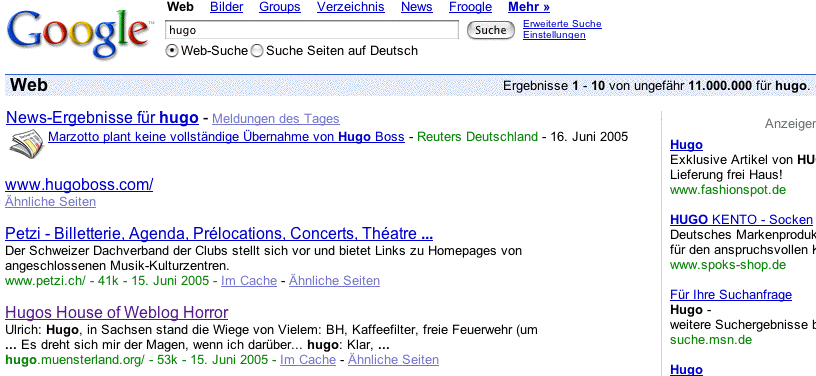
Today in Blogland
Big announcement hype, allegedly mysterious announcements, and a lot of talk. And countdowns. The most pathetic form of announcement. Countdowns. I should have been warned. But I still thought something interesting would come out. What comes out? An announcement of a blog publisher. With marketing speak. And sponsorships (which I don't even see thanks to Ad-Blocker). As exciting to me as Kottke's Payblog action. Disappointing.
Rice. Sack. China. Plop.
Enclosures in the Picture Blog
I've now patched the image upload code over at hugoesk.de to generate the necessary data for Enclosures. This way, Newsreaders that support Enclosures not only get the preview image but also the original image (usually 1800x1200 pixels - suitable for enlargements up to 10x15cm). For Newsreaders that don't support Enclosures, everything remains the same. Let's see what iTunes will do with this - it should also be able to handle artwork. Although this is probably intended for covers of MP3 Enclosures - possibly the images won't automatically end up in iPhoto (where they belong) but in iTunes as covers for non-existent albums ...
Podcasts and the Governor
Arnie podcasted: Welcome to California. What the hell.
Photon iPhoto Plugin
Photon is a very nice iPhoto plugin that allows you to easily post pictures from iPhoto to a MetaWeblogAPI-compatible blog (e.g. WordPress). The pictures that were just uploaded come from it. Photon uses the image data in iPhoto, so you finally have something to give your pictures titles (with Snail ... I did it wrong - that's why the link is so cryptic). I like the plugin ... What doesn't work quite right again is using it with my own photo blog on hugoesk.de - there I use my own WordPress plugin that manages all the metadata. Let's see if I can hack something together that automatically adds the missing metadata (e.g. EXIF data and photo assignment) from MetaWeblogAPI posts via Photon, or if I will continue to work classically with file export from iPhoto and subsequent upload. By the way, the two uploaded photos were previously RAW images - iPhoto handles the RAWs of the 10D very well. And the new editing window in iPhoto is also quite usable. However, iPhoto has a stupid bug: it only writes reduced EXIF data to the JPG when exporting to disk. The aperture, time, and focal length are included - but the original date is missing. Quite annoying when the target software generates an entry date from it (as hugoesk does). In addition, iPhoto only imports the .CRW files, not the .THM files (which store additional setting data). On the one hand, these data are missing in iPhoto, and on the other hand, memory cards gradually fill up because the .THM files remain and take up space. At least when you use the delete originals option in iPhoto. I definitely have too many photo management systems in use.